You found a listing. The price looks right. The seller replies fast. You're ready to move. Then you wire the deposit and the messages stop coming.
That scenario plays out in the used industrial robots wholesale market more than most buyers ever hear about. I've seen it from both sides. Here's the exact checklist I'd use myself before sending a single dollar.
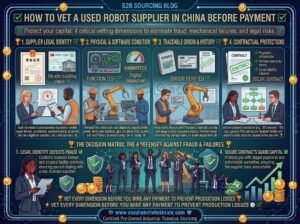
To verify a used robot supplier has real stock, check four things: their factory authorization and a valid business license, the robot's full serial number history and real working hours, their physical warehouse either in person or live on camera, and their written warranty and after-sales terms. Any supplier who stalls on even one of these is already giving you the answer.
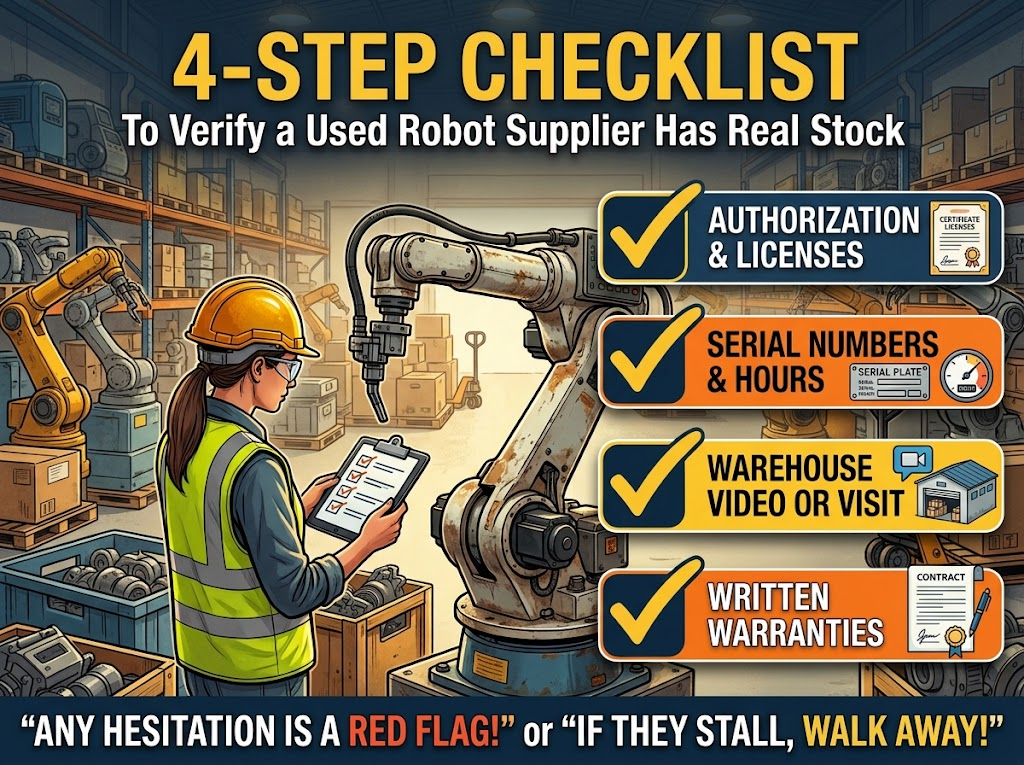
Here's the core problem. Most buyers enter this market cold. They have no price benchmark, no technical baseline, and no idea what a legitimate operation even looks like. Second hand factory automation robots represent a real, deep market with genuine value, but that same opacity creates a perfect environment for fake listings to thrive. The good news is this: once you know what to check, the fakes become easy to spot. Let's go through every layer.
Why Is This Market Full of Fake Listings in the First Place?
You'd think a fake listing would be obvious. It isn't, especially when most buyers have never bought a used robot before and have nothing to compare a quote against. Scammers know that. They count on it.
Ground-level experience across this industry consistently shows that 80 to 90 percent of manufacturing owners don't know surplus industrial automation equipment exists as a real purchasing option. Some assume robots can't be resold. Others think cost-effective industrial robots must mean scrap. That gap is exactly what a fake listing exploits. A below-market price feels like a deal to someone with no reference point.
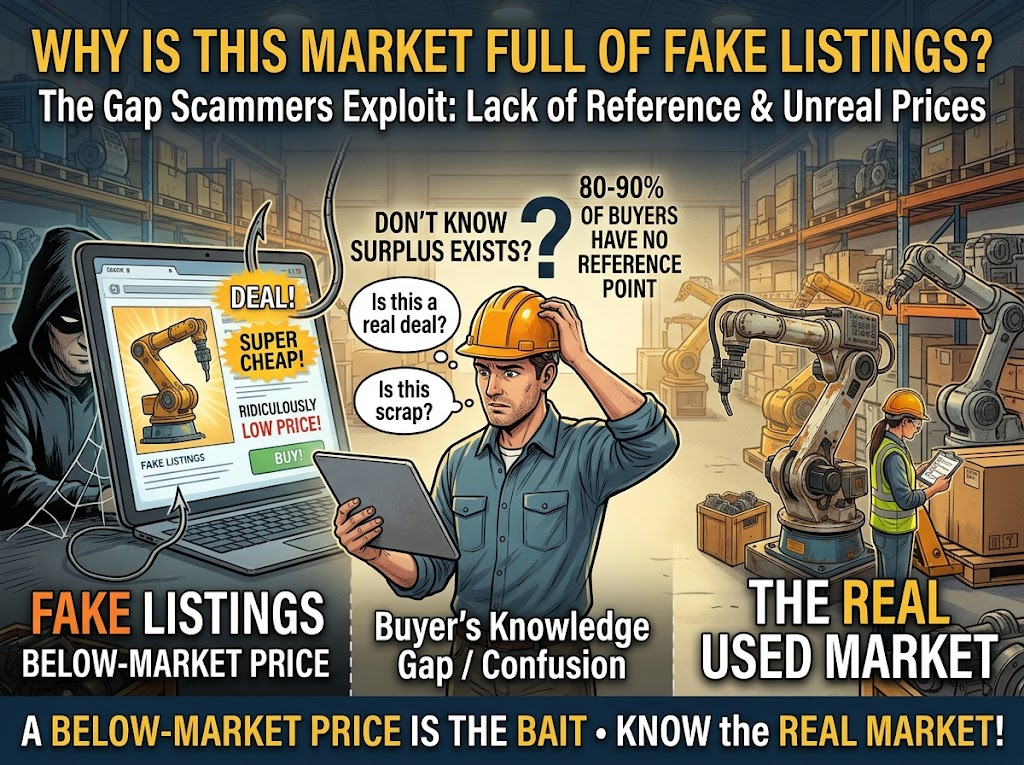
The classic deposit scam follows one pattern every time
- 🔴 Seller posts a robot at a price noticeably below every other quote on the market
- 🔴 Buyer inquires and gets an unusually fast, friendly reply
- 🔴 Seller creates urgency: "Another buyer is ready to pay, I need a deposit today"
- 🔴 Deposit clears, communication drops to silence, no robot ever ships
I've heard of buyers losing a deposit on a robot listed at roughly half the correct street price. The low price wasn't a deal. It was the mechanism of the scam.
🚨 Rule of thumb: If one quote is dramatically lower than every other supplier you've checked, treat that gap as a warning signal, not a windfall. Real pre-owned robotic arms distributors with actual inventory don't need price pressure to close deals. The urgency only exists when there's nothing real to show you.
What makes the used robot market specifically vulnerable
- No centralized price registry or public market database
- Technical complexity that most buyers can't immediately verify
- High unit values that make a deposit feel reasonable before inspection
- Global sourcing means the buyer and the machine are rarely in the same city
Understanding why the scam works is the first step to not falling for it. The next steps are practical verification, and we start with the paperwork.
How Do You Check a Supplier's Authorization and Business License?
Most suppliers will tell you they're authorized and experienced. Almost none volunteer the actual documents unprompted. Asking for them is the single fastest filter in this whole process.
Check two documents first: a brand authorization certificate from FANUC, ABB, KUKA, or Yaskawa showing the supplier as a recognized dealer, and a business license with robot sales, repair, and integration listed in the registered scope. Then verify the authorization against the brand's official dealer registry online. If either document is missing, vague, or can't be cross-checked, walk away.
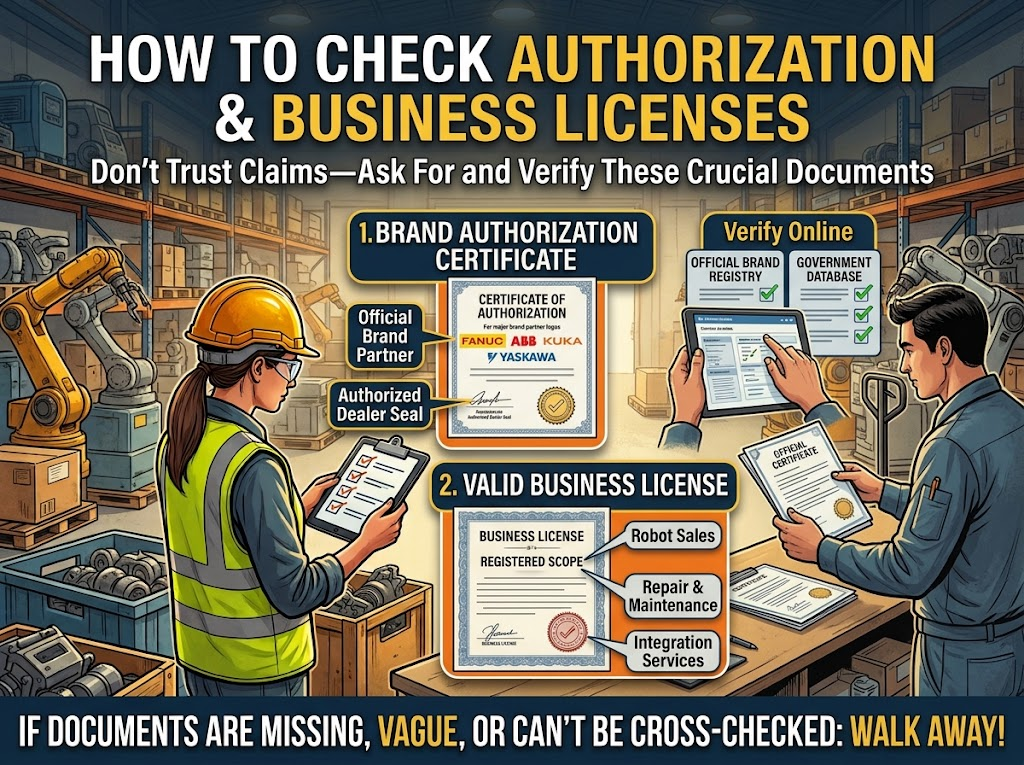
How to verify the authorization certificate
Step 1 — Get the physical certificate
Ask for a copy that clearly shows:
- The brand name (FANUC, ABB, KUKA, Yaskawa)
- The dealer's legal company name matching their business license
- A validity period that is currently active
Step 2 — Cross-check on the brand's official website
Every major robot brand maintains a dealer locator or partner directory online. Search the supplier's company name. If they're not listed or their region doesn't match, that certificate is worth nothing.
Step 3 — Read the business license scope
A genuine used robot supplier China buyers can trust will have these activities registered:
| Registered scope item | Why it matters |
|---|---|
| Industrial robot sales | They're legally authorized to sell |
| Robot repair and maintenance | They can legally support what they sell |
| Automation system integration | They have real technical service capability |
A company registered only as a "general trade company" with no technical scope is a shell operation.
Step 4 — Check company age
A brand-new company with no verifiable history carries far more risk than one with a decade of customer references behind it. We've operated since 2012. Our license, authorizations, and customer record are open for verification before you even ask. Explore our full used robots catalog, organized by brand, to see what we actually stock, not just what we claim.
How Do You Trace a Robot's Real History Before Buying?
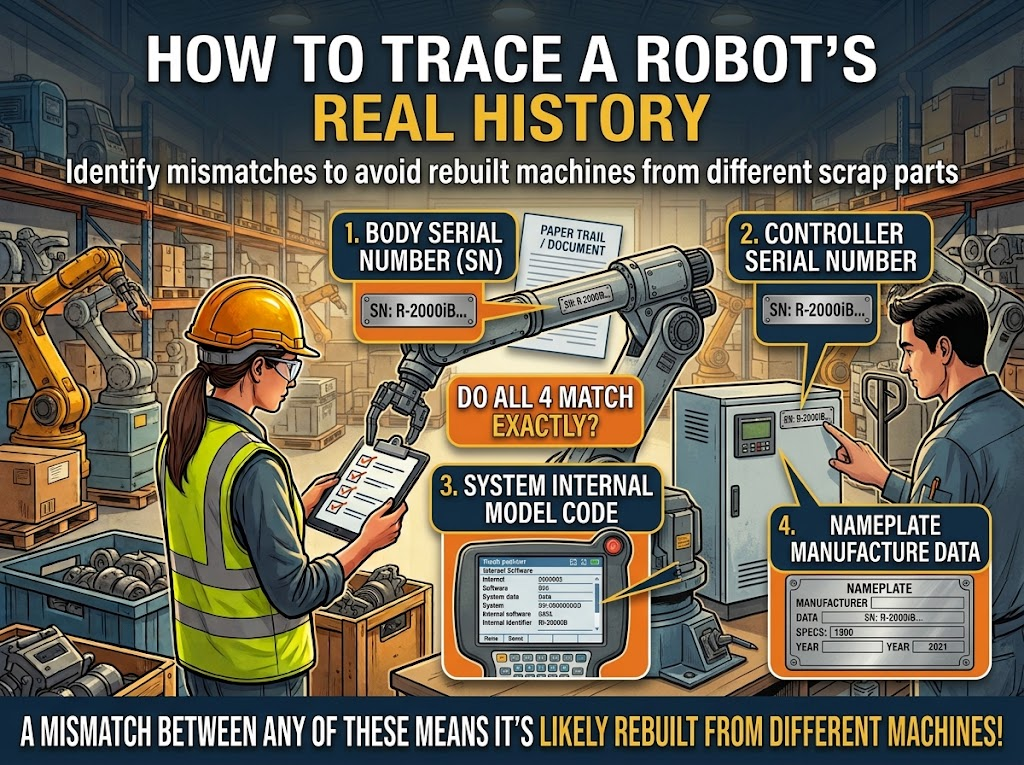
A photo tells you absolutely nothing useful. Anyone can post someone else's photo. What you need is the paper trail that physically follows the machine. Here's how to read it.
Ask for the robot's four identifiers: the body serial number (SN), the controller serial number, the system internal model code, and the nameplate manufacture data. All four should match exactly. A mismatch between any two means the unit is likely a refurbished industrial robotic arm rebuilt from components pulled off different machines, not an original factory unit.
Cross-check the hour meter against physical wear
Hour meters can be reset. A middleman hiding a machine's real usage history has the tools and the incentive to do exactly that. So never trust the number alone.
Cross-check it against three physical signals:
| Physical signal | What it actually tells you |
|---|---|
| Grease condition on all axis joints | Matches claimed hours, or contradicts them |
| Cable and harness wear | Heavy use shows up in fraying and discoloration |
| Connector corrosion on electrical interfaces | Reveals real environmental exposure and age |
| Manufacture date on the body nameplate | Sets a hard ceiling on plausible working hours |
If the system reports 8,000 hours but the harness looks like it's done 30,000, that's a question worth asking. A genuine supplier will have a straight answer. A middleman will get defensive.
Ask where the machine actually came from
Legitimate sourcing channels produce traceable histories:
- ✅ Factory production line upgrades — manufacturer retired old models, units are fully documented
- ✅ Project surplus — line never deployed, machine may be near-new condition
- ✅ Showroom demo units — low hours, clean condition, easy to verify origin
🚩 A seller who can't name the origin isn't protecting confidential information. They don't know, because they bought the machine from another middleman, who bought it from another middleman, with no documentation preserved across those handoffs.
This traceability requirement is even more critical for parts. If you need a used KUKA KRC4 teach pendant, a specific encoder for a FANUC controller, or a replacement cable harness for a Yaskawa, the exact part number must match. We maintain full sourcing records behind every unit and every part we list. Browse used FANUC robots, used ABB robots, used KUKA robots, used Yaskawa robots, and other brands with verified histories. Our parts catalog includes teach pendants, encoders and resolvers, robot cables and harnesses, and controllers and control cabinets, all with real part numbers you can verify independently.
What Should You See When You Visit the Supplier's Warehouse?
Any supplier can describe their warehouse convincingly in a sales call. Not every supplier can walk you through it live on camera, let alone in person. That difference tells you more than any pitch ever could.
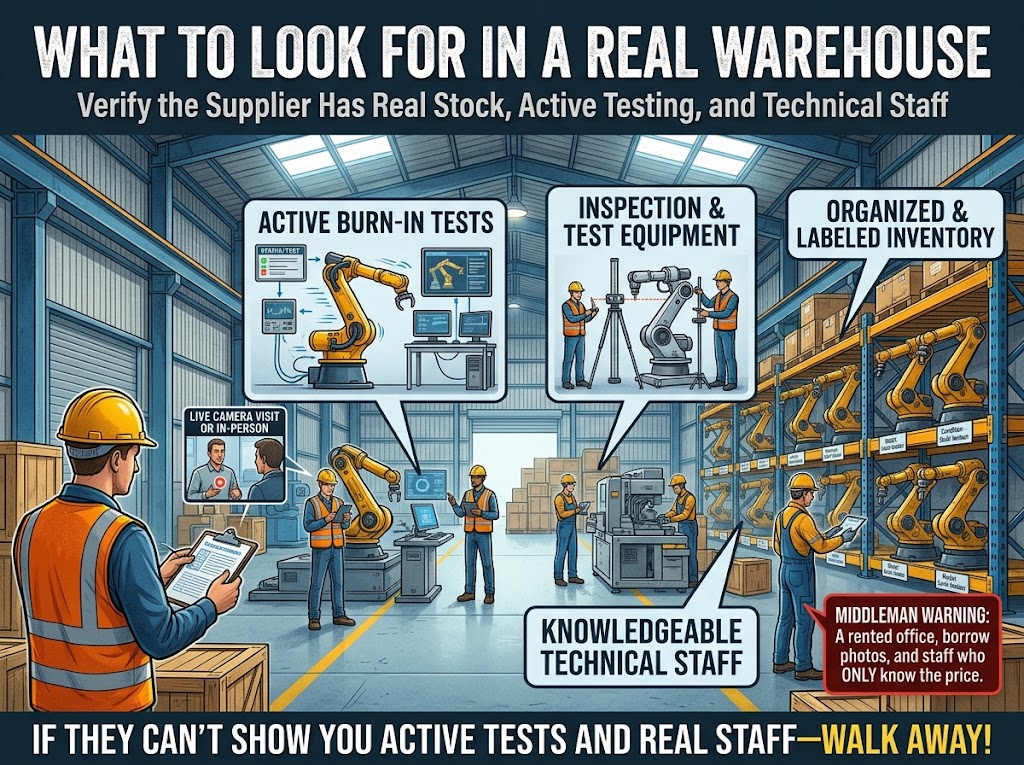
A real supplier's warehouse has machines actively running burn-in tests on the floor, a visible inspection area with real test equipment like laser interferometers, organized inventory labeled by model and condition, and technical staff who can answer detailed application questions without hesitation. A middleman's "warehouse" is usually a rented office with polished borrowed photos and a sales team that only knows the price.
Read the inventory condition itself
Inventory health reveals how a supplier actually operates. A well-run used robot business moves stock consistently. A poorly run one lets machines gather dust and pretend that's fine.
✅ Signs of a healthy, real operation
- Machines organized by brand, model, application, and condition rating
- Clearly labeled units with inspection completion dates visible
- A live industrial robot inventory list that physically matches what you see on the floor
- Fresh arrivals separated from older stock with distinct labeling
- Dead or slow-moving units actively being cleared out
🚩 Signs of a stagnant middleman stockpile
- Rows of unlabeled machines with visible dust accumulation
- No testing or inspection area anywhere on the floor
- Salespeople who can't say when a specific unit arrived or where it came from
- Showroom feels arranged for photography, not for real buyer walkthroughs
Run the technical team test before you trust anyone
Here's a test I'd recommend every buyer run before committing:
Ask a direct, specific application question. Something like:
"I need a tested industrial robot barebone for a used robot arm for welding cell work. What configuration do I need, what external components, and what's the realistic total cost?"
A properly trained sales team answers that immediately. They break down the robot model, the torch and wire feeder requirements, whether an external axis is needed for your part geometry, and a realistic integration cost range. A pure reseller stalls, deflects, or quotes you a robot body without any understanding of the actual task.
We organize our catalog by application specifically because the right machine depends on the job, not just the brand. Browse by use case: welding robots, palletizing robots, handling robots, machine tending, assembly robots, and painting and coating robots. Our available stock and new arrivals pages show exactly what's on the floor today, with no guessing required.
What Do the Contract and After-Sales Terms Tell You?
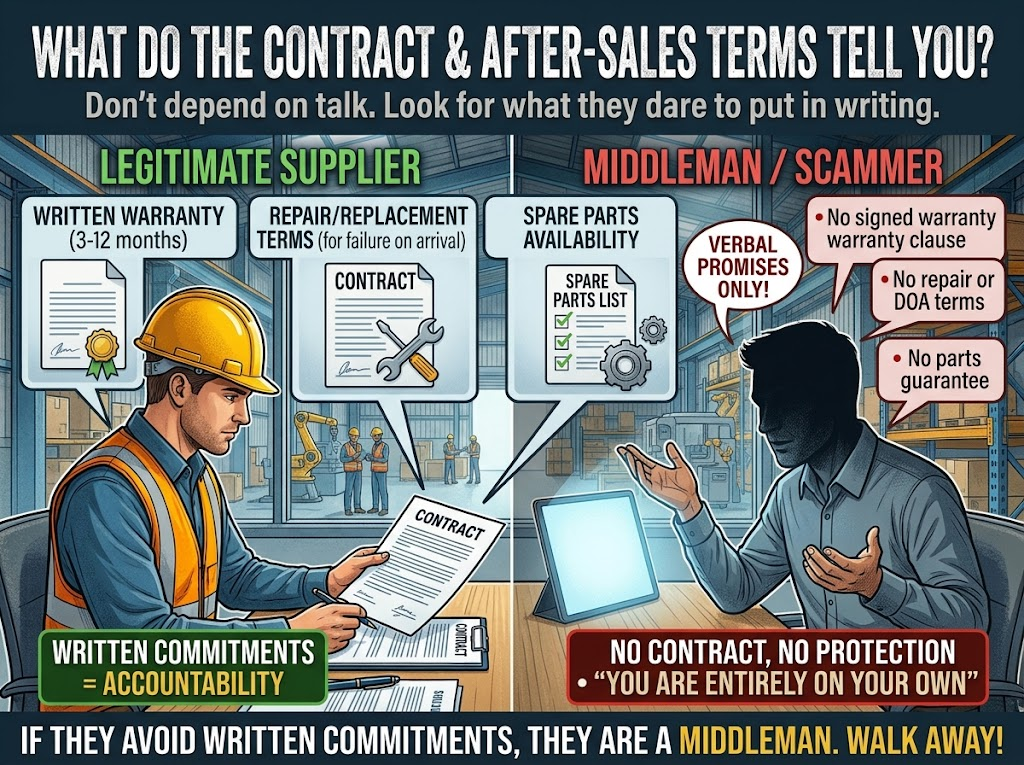
The contract is where middlemen finally show their hand. They avoid putting anything in writing because written commitments create accountability. Here's what a real supplier's terms actually look like.
A legitimate supplier provides a written warranty of 3 to 12 months depending on the unit, clearly defined terms for repair or replacement if something fails on arrival, and documented spare parts availability for the exact model you're buying. A middleman offers verbal promises only. No signed warranty clause, no repair terms, no parts commitment means one thing: once you pay, you are entirely on your own.
Read the warranty clause word by word
Ask for these specifics in writing, and don't accept vague phrases like "we'll take care of it":
- ✅ Warranty duration: minimum 3 months, ideally 6–12 for a tested unit
- ✅ Who covers return shipping on a warranty claim
- ✅ Whether the warranty covers parts, labor, or both
- ✅ Maximum response time commitment for technical support
Check their actual spare parts depth
A supplier who stands behind their machines keeps the relevant parts on the shelf. Ask them directly whether they currently stock:
- Obsolete FANUC robot parts for the specific model you're buying
- A replacement servo motor for ABB robot models in that generation
- Tested used robot spare parts with individual test reports attached
🚩 If the answer is "we can source it for you," that means they don't have it today. Sourcing takes days. When your production line is stopped, every hour costs real money.
Browse our spare parts depth before you decide: robot spare parts covering servo motors, servo drives and amplifiers, control boards and mainboards, power supply modules, I/O modules and communication boards, reducers and gearboxes, and all other robot parts.
A supplier who offers a rental model is making a statement
A monthly rental that bundles full after-sales support, like a lease covering a used palletizing robot system or a complete used welding robot, only works financially if the supplier is genuinely confident the machine will stay running. No middleman offers that model, because they can't. It requires real technical staff, real spare parts inventory, and real accountability for performance.
That rental model also reduces your risk directly. Instead of committing a large upfront capital amount, you test the machine in your actual production environment first and let performance justify the spend. That level of confidence cannot be faked.
Conclusion
Check the license, trace the machine, visit the warehouse, and read the contract. Four steps, no shortcuts. That's everything between you and a robot that actually runs.
If you want a supplier who passes all four checks, Pengju Robotics has done this since 2012. Browse our all used robots catalog, check our robot parts inventory, or read more buyer guides on our blog.
About Pengju Robotics
![]()
Pengju Robotics Co., Ltd. has traded used industrial robots since 2012. We handle imported robot trading, automation integration projects, equipment leasing, robot and spare parts sales, repair, maintenance, and technical training across four service centers in Shenzhen, Chongqing, Xiong'an, and our headquarters in Changsha.
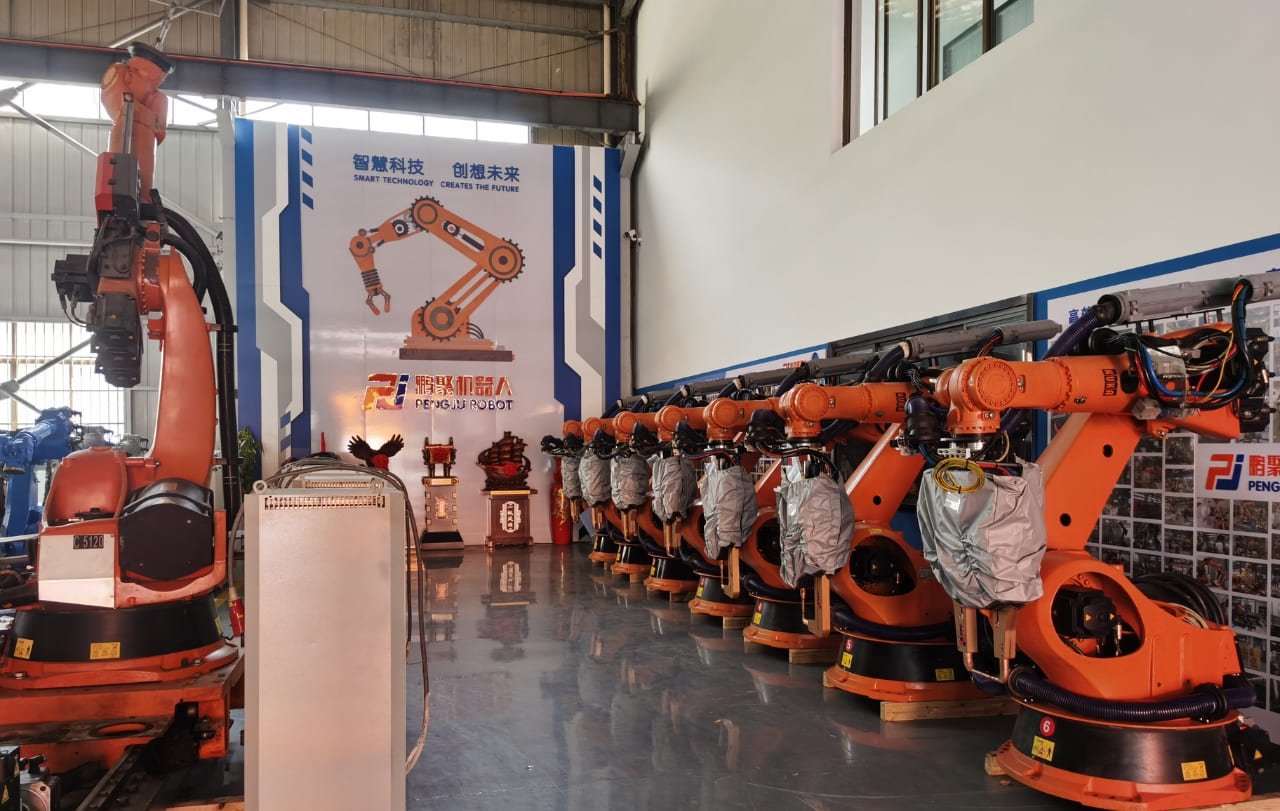
We are not a pure systems integrator and we are not a refurbishing shop flipping machines for a quick margin. Our edge is a global sourcing network, real physical inventory of 1,000+ units, a dedicated used-robot showroom, 14+ years of industry track record, in-house inspection capability, and worldwide logistics delivery.
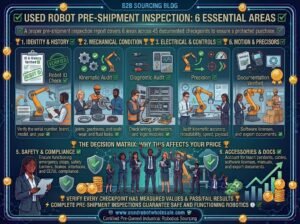
Our team divides into three groups: 25% simulation and design engineers, 45% on-site commissioning and field engineers, and 30% sales and after-sales staff. Every unit that leaves our warehouse passes a 45-item outgoing inspection covering the robot body, control cabinet, and teach pendant individually.
Our standard since day one: strictly abide by every standard, responsible for perfect delivery.
🏢 Company: Pengju Robotics Co., Ltd.
📍 Address: No. 3, Maqiaohe Road, Wangcheng District, Changsha City, Hunan Province, China
📧 Email: sales@pengjurobotics.com (primary) · purchase@pengjurobotics.com · info@pengjurobotics.com
📱 WhatsApp / WeChat (Tony): +86 18123897892
Reach us through our contact page or learn more about us.