Your production robot just threw a fault code and the line is down. Every hour costs money. What you do in the next 30 minutes determines whether you're back online tomorrow or next week.
Whether you need a replacement servo motor for an ABB robot, a used KUKA KRC4 teach pendant, or any tested used robot spare parts from a supplier in China, the answer to "how fast can this get here" is not fixed. It depends on decisions you make right now.
International emergency robot spare parts can arrive in 24–48 hours via On-Board Courier hand-carry, 48–72 hours via DHL or FedEx express with rush customs clearance for parts under 1 ton, 7–15 days via standard air freight for heavier batches, or 30–50 days by sea for non-urgent large components. Actual delivery time depends on shipping method, cargo classification, customs clearance efficiency, and last-mile distance.
![how fast emergency robot spare parts ship internationally DHL FedEx guide timeline]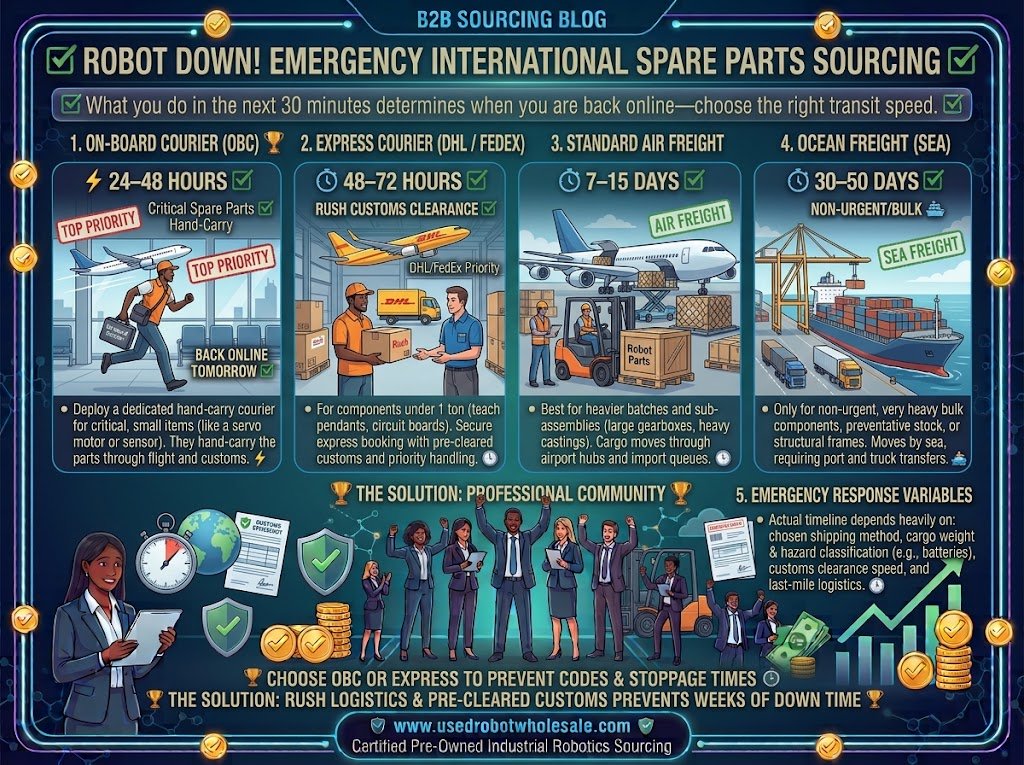 "How fast can emergency robot spare parts ship internationally DHL FedEx guide")
Here's the honest picture of the used industrial robots wholesale supply chain. A complete used welding robot, a used robot arm for welding cell production, a used palletizing robot system, or any cost-effective industrial robot keeping a factory running can go from producing output to full stop on a single component failure. When second hand factory automation robots break down, the supplier's job is to get the right part there before the cost becomes permanent. Let me walk through every shipping option from fastest to slowest, and exactly what determines which one you can actually use.
What Are the Four International Shipping Methods for Robot Parts?
You have four options, and choosing the wrong one adds days to your downtime. Each method fits a specific situation. Knowing the difference before you call your supplier saves the most time.
Four methods cover international emergency robot spare part shipments: express courier (DHL/FedEx) for high-value parts under 1 ton delivering in 48–72 hours, On-Board Courier (OBC) for absolute emergencies at 24–48 hours door-to-door, standard air freight for heavier batches at 7–15 days, and sea freight for non-urgent large equipment at 30–50 days. Robot line emergencies belong in the first two categories only.
![four international shipping methods robot spare parts comparison timeline chart]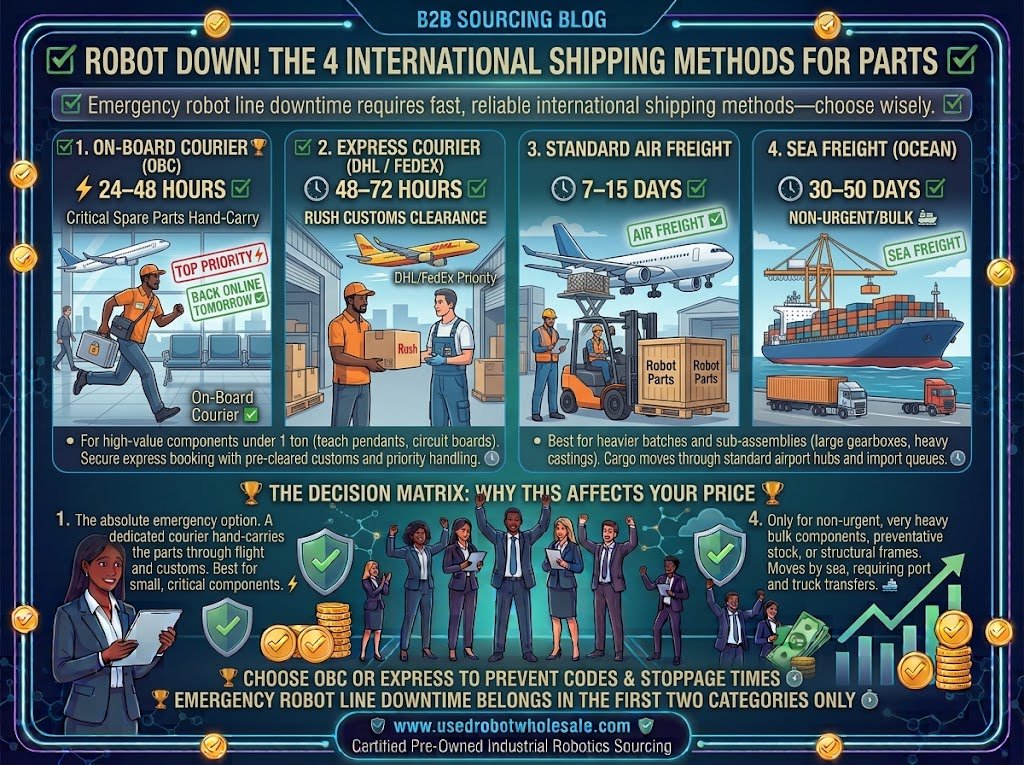 "Four international shipping methods for emergency robot spare parts comparison chart")
The four methods at a glance
| Shipping method | Typical timeline | Best use case |
|---|---|---|
| ✈️ Express courier (DHL / FedEx) | 48–72 hours | Parts under 1 ton, high value, small-to-medium size |
| 👤 On-Board Courier (OBC) | 24–48 hours | Single critical part, absolute line-down emergency |
| 🛫 Standard air freight | 7–15 days | Batch orders over 1 ton, non-urgent restocking |
| 🚢 Sea freight | 30–50 days | Large equipment, no urgency, lowest cost priority |
Method 1 — Express courier (DHL / FedEx): the right default choice
For most robot spare part emergencies, DHL International Express or FedEx International Priority is the correct answer. Servo amplifiers, control boards, teach pendants, cable harnesses, and most electronic components fall well within the weight and size parameters that these services handle every day.
From major Chinese shipping hubs, express services reach most European, North American, and Southeast Asian industrial cities in 48–72 hours under standard conditions. The network is reliable, tracking is real-time, and customs broker relationships at major destination airports are already established.
Method 2 — On-Board Courier (OBC): for when hours matter more than cost
OBC means a professional courier physically carries your part as carry-on baggage on a direct commercial flight. There's no cargo queue, no freighter schedule dependency, and no separate customs channel. The courier exits the aircraft, clears customs in person, and delivers directly to your location. This service is genuinely 24–48 hours door-to-door in most scenarios.
Method 3 — Standard air freight: for batches, not emergencies
When a facility needs multiple parts or heavier components that don't justify express pricing, standard air freight works at 7–15 days. Not suitable for a robot that's currently stopped.
Method 4 — Sea freight: not an emergency solution
Sea freight runs 30–50 days. If your robot is down and the part is on a container ship, your line is down for over a month. Sea freight has no role in robot maintenance emergencies.
How Fast Does DHL or FedEx Actually Deliver Robot Spare Parts?
The published delivery windows are accurate for standard shipments under standard conditions. Robot spare parts sometimes meet that description. Sometimes they don't. Here's what the actual timeline looks like broken down by stage.
DHL International Express and FedEx International Priority deliver robot spare parts from China to most major industrial destinations in 48–72 hours under normal conditions. This includes same-day origin processing, 12–24 hours of direct flight transit, and 2–6 hours of customs clearance plus local last-mile delivery. Parts requiring special cargo handling or documentation add 24–48 hours to that baseline.
![DHL FedEx express delivery stage by stage timeline robot spare parts China international]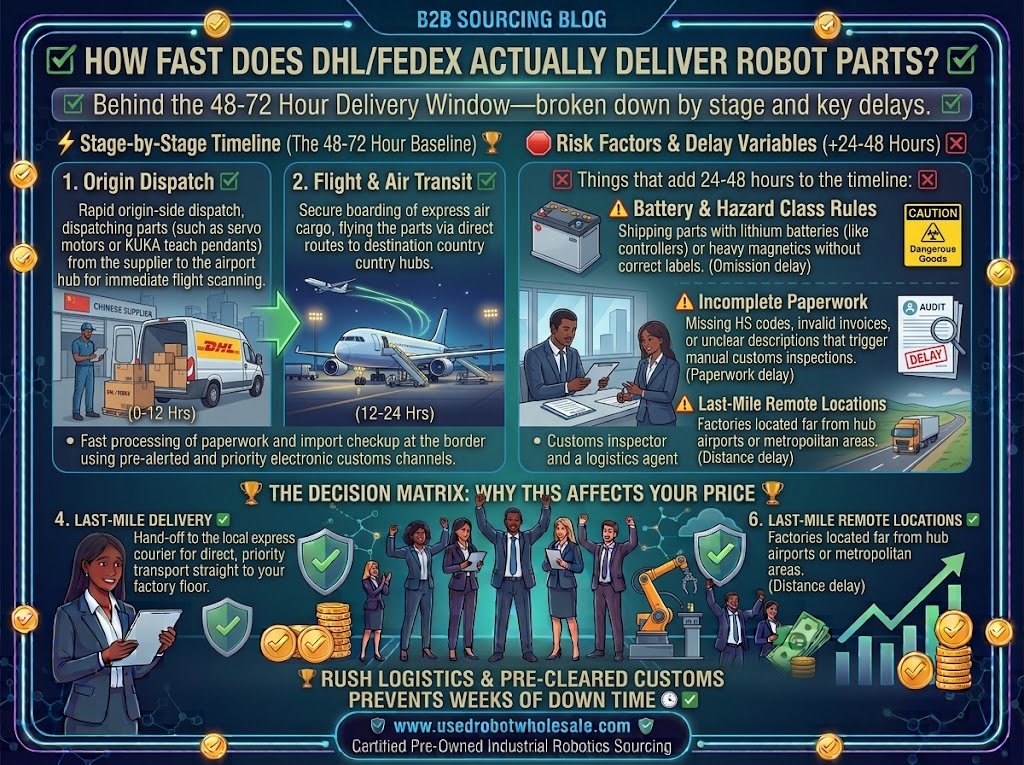 "DHL FedEx express delivery stage by stage timeline robot parts China to international")
Stage-by-stage timeline from China to a European industrial facility
| Stage | Time required | Key variable |
|---|---|---|
| Supplier picks, packs, books | 2–4 hours | Same-day order before daily cutoff required |
| Origin pickup and departure scan | 2–6 hours | Courier pickup cutoff times are fixed |
| Direct flight or hub transit | 12–24 hours | Direct routing available from major Chinese hubs |
| Customs clearance at destination | 2–6 hours (standard) | Rises to 24–48 hours for complex cargo types |
| Last-mile delivery to facility | 2–8 hours | Depends on distance from courier depot |
| Best case total | ~24–36 hours | Direct flight, pre-filed docs, urban location |
| Standard case total | ~48–72 hours | Normal routing, standard clearance, typical address |
What DHL and FedEx actually do differently for industrial shipments
Both carriers provide dedicated industrial B2B service levels. For high-priority robot component shipments, both can:
- Pre-file customs documentation electronically before the shipment lands at destination
- Assign a local customs broker for the destination country's clearance process
- Provide real-time shipment tracking with proactive exception alerts
- Handle shock-monitored packaging for sensitive electronic components
📦 The biggest variable isn't the carrier. It's the documentation quality at origin. A shipment with a correct commercial invoice, accurate HS tariff code, and complete declared value clears customs in 2–6 hours. A shipment with documentation errors sits for 2–4 days regardless of which premium carrier is moving it.
We've shipped tested used robot spare parts including obsolete FANUC robot parts, servo drives, and encoder modules to Europe, Southeast Asia, and North America via DHL within 48–72 hours from our Changsha facility. The part arrives. The line restarts. Browse our robot spare parts catalog and available stock to check real-time inventory before you call.
When Does an On-Board Courier Make Sense for a Robot Emergency?
Most buyers don't know OBC exists as a commercial service. Those who discover it usually do so mid-emergency when the DHL 48-hour timeline is still too long for the situation at hand.
On-Board Courier (OBC) service means a professional courier physically carries your spare part as cabin luggage on a scheduled commercial flight, clears customs in person at destination, and delivers directly to your facility. OBC delivers in 24–48 hours door-to-door in most scenarios, with same-day delivery possible on short-haul routes. The service premium is significant but is almost always less than continued production downtime costs.
![on-board courier OBC emergency robot spare part delivery hand-carry 24 hours door-to-door]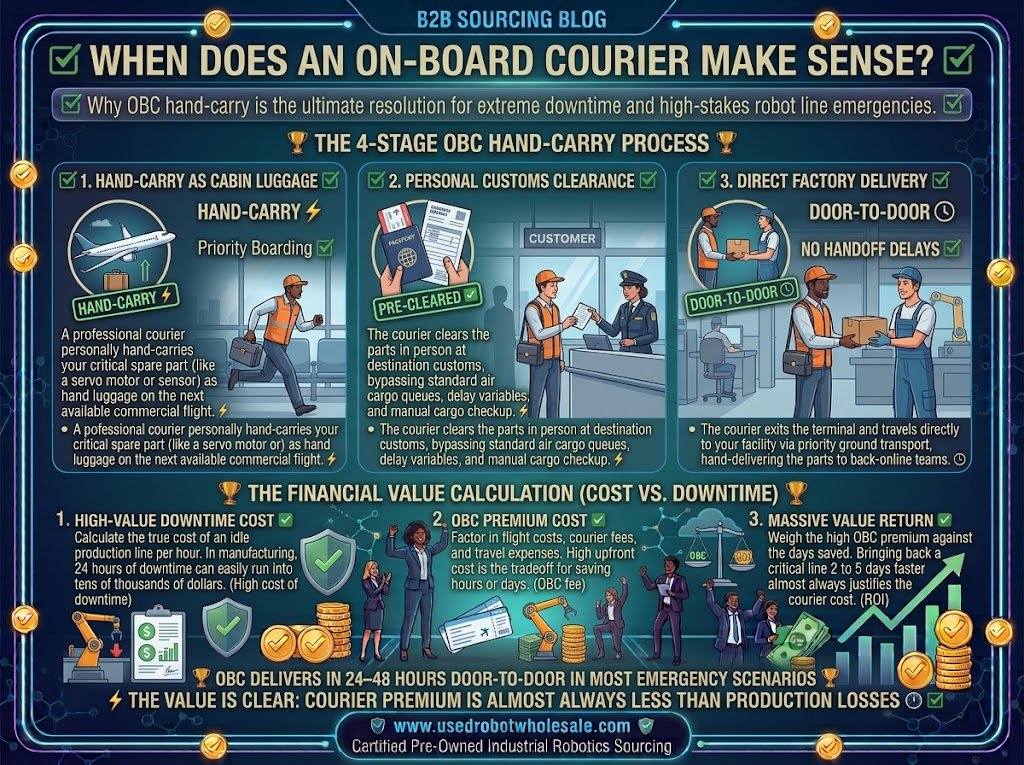 "On-Board Courier OBC emergency robot spare part hand-carry delivery 24 hours")
When OBC is the correct economic decision
The calculation is direct. Compare the OBC service premium against your hourly downtime cost.
A simple OBC cost justification
| Variable | High-value line | Standard line |
|---|---|---|
| Hourly downtime cost | 2,000 USD | 500 USD |
| DHL delivery time | 72 hours | 72 hours |
| OBC delivery time | 30 hours | 30 hours |
| Hours saved by choosing OBC | 42 hours | 42 hours |
| Downtime cost saved | 84,000 USD | 21,000 USD |
| Typical OBC premium over express | ~1,500–3,000 USD | ~1,500–3,000 USD |
| Financial justification | ✅ Strongly justified | ✅ Still justified |
For any production line where downtime costs exceed a few hundred dollars per hour, OBC is almost always the financially rational choice for a single critical component.
What OBC actually involves operationally
- The courier collects the packaged part directly from your supplier's facility
- They board the earliest available direct commercial flight to the destination country
- On arrival, they clear customs as a traveler with declared commercial cargo
- They deliver to your facility — often within 15–60 minutes of landing
💡 Not every supplier can support OBC. It requires the part to be physically ready, packaged to cabin-baggage standards, and commercial documentation prepared before the courier's departure time. Ask your supplier directly whether same-day OBC booking is possible before committing to this route.
OBC limitations to know in advance
- Weight limit: most couriers work with parts up to 20–32kg per flight
- Lithium battery restrictions may prevent carry-on entirely on certain routes
- Not available from all origin cities — requires proximity to an international hub with direct routes to the destination
- Premium pricing: expect 3–8x the cost of standard express for the same route
What Cargo Properties and Customs Clearance Actually Affect Delivery?
Every robot spare part ships differently based on what it physically contains. Customs authorities treat a servo motor and a battery-equipped controller very differently, and that difference can add 24–48 hours to your timeline with no warning.
The two biggest variables inside any express or OBC delivery window are cargo classification and customs documentation completeness. Standard electronic parts clear customs in 2–6 hours with a complete documentation package. Parts containing lithium batteries, hydraulic fluid, permanent magnets, or other regulated materials require compliance documentation that extends customs clearance to 24–48 hours regardless of carrier or service level.
![cargo classification customs clearance robot spare parts international shipping time factors]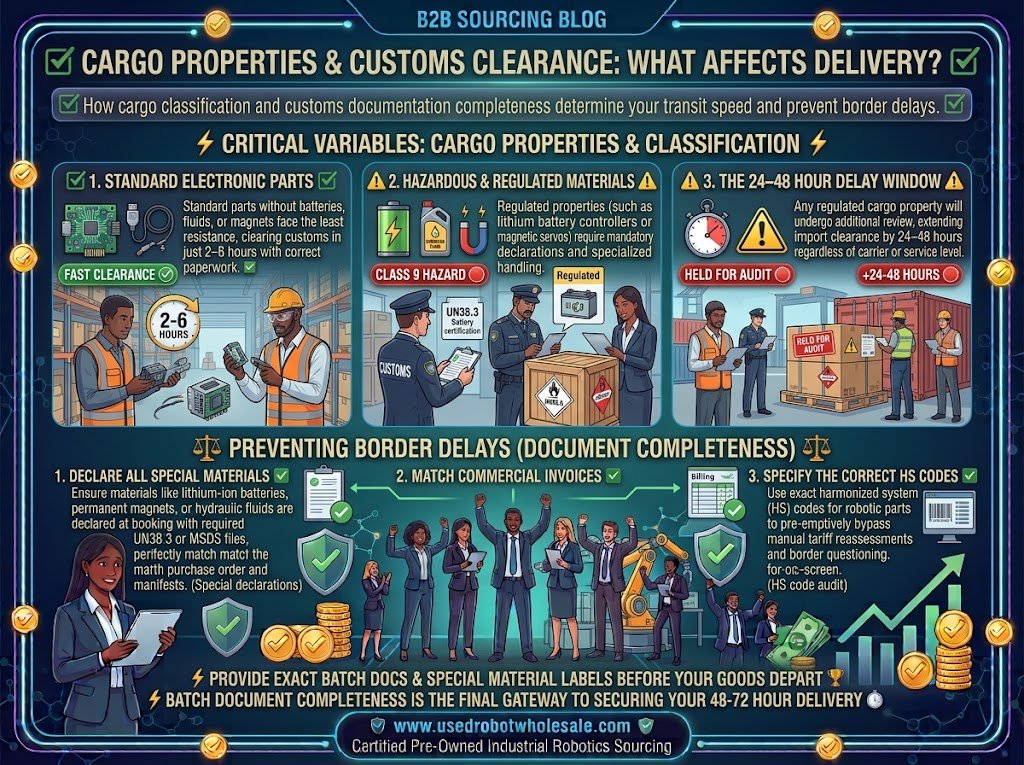 "Cargo classification and customs clearance factors affecting robot spare parts shipping time")
How cargo type changes your clearance timeline
| Part type | Classification | Typical clearance | What's required |
|---|---|---|---|
| Standard servo motor | General electronics | 2–6 hours | Standard commercial invoice |
| Servo drive/amplifier | General electronics | 2–6 hours | Standard documentation |
| Battery backup module (Li-ion) | Dangerous goods Class 9 | 24–48 hours | IATA DG declaration required |
| Hydraulic balance cylinder | Restricted liquid | 12–24 hours | MSDS and content declaration |
| Motor with permanent magnets | Magnetic material | 4–12 hours | Magnetic field strength declaration |
| Used KUKA KRC4 teach pendant (battery-equipped) | Mixed classification | 12–24 hours | Battery assessment and DG declaration |
The documentation checklist that determines clearance speed
Every hour of preventable customs delay starts with a documentation gap. A complete pre-filed package includes:
- ✅ Commercial invoice with accurate declared value and correct HS tariff code
- ✅ Packing list with exact gross weight and outer dimensions
- ✅ Part number, brand, model reference, and end-use declaration
- ✅ MSDS (Material Safety Data Sheet) for batteries, fluids, or magnetic parts
- ✅ Importer of Record (IOR) name and address at destination
- ✅ Any country-specific import licenses required at the destination
⚠️ The single most common clearance delay: Wrong or missing HS code on the commercial invoice. Customs flags the shipment for manual review, adding 1–3 business days. An experienced export team knows the correct codes for servo motors (8501), servo drives (8504), encoders (9014), and teach pendants (8537) before the shipping label is printed.
Last-mile delivery: the variable most buyers overlook
The airport is not your factory. After customs clearance, the part still needs to travel from the airport depot to your specific facility. For standard urban and suburban industrial addresses, this adds 2–8 hours with normal courier delivery. For remote industrial zones, facilities with restricted access windows, or components requiring specialized unloading equipment, last-mile can add a full day to an otherwise fast shipment.
If your plant has specific delivery constraints — access hour restrictions, forklift requirements, security clearance procedures — tell your supplier before the shipment is booked. Carriers can pre-arrange local delivery in some cases, but cannot retroactively reroute a shipment that's already in transit to the wrong depot.
What Should You Do the Moment Your Robot Line Goes Down?
The first 30 minutes after a robot failure determine whether you lose one day or five. Most buyers waste this time by moving through the wrong sequence.
When a robot production line goes down, take four actions immediately: identify the exact fault code and required part number from the controller diagnostic screen, call your primary supplier to confirm real physical stock (not just catalog listing), decide on your shipping method based on downtime cost versus delivery premium, and send complete importer information and customs documents to the supplier at the same time you confirm the order.
![what to do immediately robot production line down emergency spare parts procedure steps]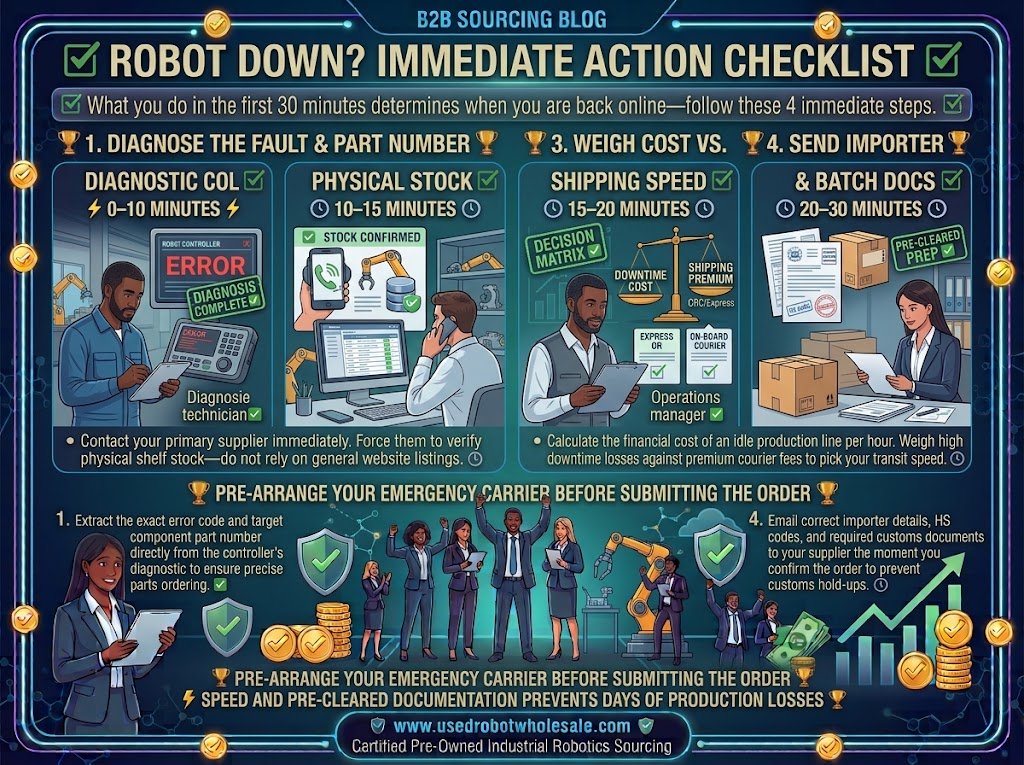 "What to do immediately when robot production line goes down emergency spare parts steps")
The first 30-minute action sequence
Step 1 — Diagnose precisely, not approximately
Pull the exact fault code from the controller. Note the robot model, series, and full serial number. Find the specific part number in the maintenance manual or the controller's diagnostic module. This takes 5–10 minutes and eliminates an entire round of back-and-forth over wrong part specifications.
Step 2 — Call, don't email
For a line-down emergency, a phone call gets a real answer in minutes. A genuine used robot supplier China buyers depend on for emergencies has a technical person available who can confirm physical stock in real time. A real pre-owned robotic arms distributor with actual inventory answers that question immediately.
🚩 If the first reply is "let me check and get back to you tomorrow," call the next number on your list.
Step 3 — Make your shipping method decision before you call
Know before you dial whether you want:
- DHL/FedEx express — your default for most situations under normal urgency
- OBC hand-carry — when your hourly downtime cost justifies the premium
This prevents the conversation from stalling while you decide. Your supplier can book the service the moment you confirm the order.
Step 4 — Send documentation-ready information immediately
Don't wait for the supplier to ask for it. Send your facility's import information, the importer of record name and address, and any destination country-specific import requirements at the same time you confirm the order. Pre-submitted documentation is the single biggest controllable factor in cutting customs clearance time.
What a supplier who can handle emergencies actually looks like
| Capability | Why it matters for emergency shipment |
|---|---|
| Real physical inventory (not sourced on demand) | Same-day shipping requires the part to already be on a shelf |
| Experienced export documentation team | Pre-filed customs docs eliminate the most common clearance delays |
| Established DHL/FedEx account | Preferred account holders get priority pickup and processing |
| Technical staff available during your call | Correct part confirmation requires a real engineer, not a sales rep |
We maintain a real stock of robot spare parts at our Changsha facility — including servo motors, servo drives and amplifiers, encoders and resolvers, teach pendants, control boards and mainboards, power supply modules, I/O modules and communication boards, and reducers and gearboxes. Whether you're sourcing parts for used FANUC robots in stock at your plant or tracking down a component for a refurbished industrial robotic arm that's already in production, same-day DHL dispatch is available for confirmed in-stock items ordered before our daily cutoff. Check available stock and new arrivals for real-time availability.
Conclusion
48–72 hours via express, 24–48 via OBC, 7–15 days by standard air. Match the method to your downtime cost, get the part number right in the first call, and send your customs documents before anyone asks. That's how you cut a week of downtime to a day.
For international emergency spare parts dispatch from China, contact Pengju Robotics for same-day shipping availability. Browse our robot parts catalog or read more operational guides on our blog.
About Pengju Robotics

Pengju Robotics Co., Ltd. has operated in the used industrial robot and spare parts market since 2012. We handle robot trading, automation integration, equipment leasing, robot and spare parts sales, repair, maintenance, and technical training from service centers in Shenzhen, Chongqing, Xiong'an, and Changsha.
We maintain over 1,000 units in physical inventory with same-day international shipping capability via DHL and FedEx for in-stock parts. Our team includes engineering staff who confirm part compatibility during your call, not in a reply the following day.
Our standard since day one: strictly abide by every standard, responsible for perfect delivery.
🏢 Company: Pengju Robotics Co., Ltd.
📍 Address: No. 3, Maqiaohe Road, Wangcheng District, Changsha City, Hunan Province, China
📧 Email: sales@pengjurobotics.com (primary) · purchase@pengjurobotics.com · info@pengjurobotics.com
📱 WhatsApp / WeChat (Tony): +86 18123897892
Reach us through our contact page or learn more about us.