You power up a used robot on day one and it throws a fault code in the first hour. No inspection report exists. No documentation of what was tested before it left the seller's floor. That problem was entirely preventable.
Whether you're buying a single refurbished industrial robotic arm or sourcing a batch in the used industrial robots wholesale market, the pre-shipment inspection report is the document that separates a protected purchase from a gamble.
A proper pre-shipment inspection report for a used robot covers six areas across 45 documented checkpoints: equipment identity and history, appearance and mechanical condition, electrical and control systems, motion and precision performance, safety and compliance, and accessories and documentation. Every checkpoint should carry a pass/fail result, actual measured values where applicable, and notes from the inspection engineer.
![used robot pre-shipment inspection report 45 point checklist structure complete]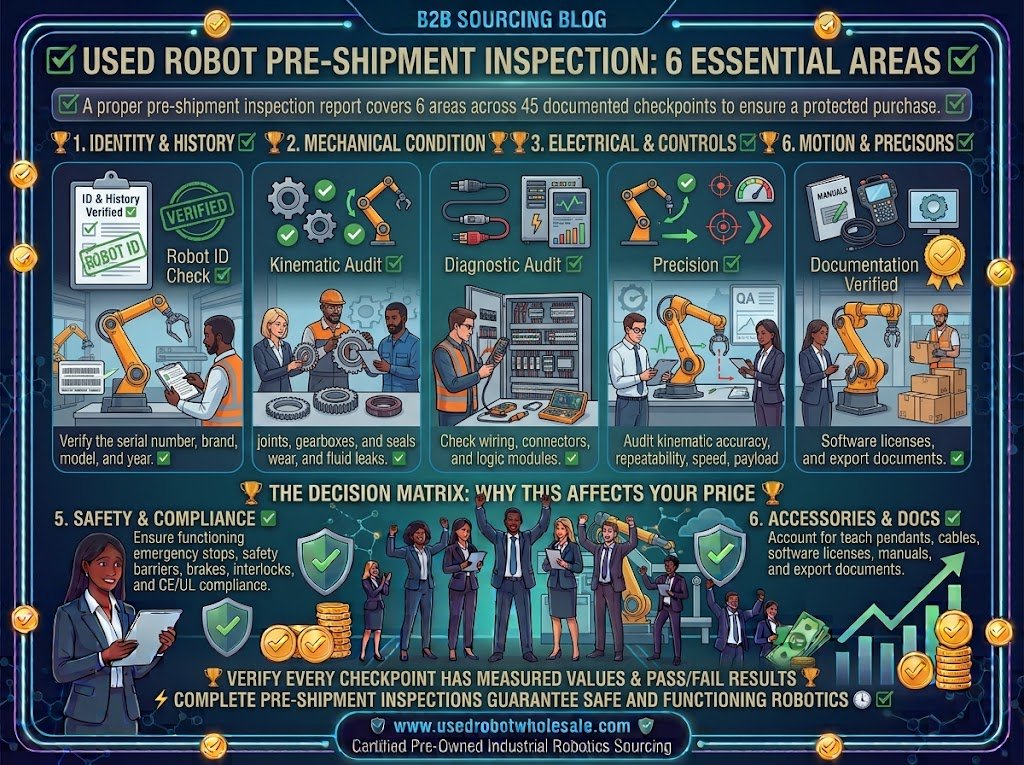 "What a complete used robot pre-shipment inspection report should include")
Most buyers of cost-effective industrial robots focus entirely on price. That's understandable. But a robot that wasn't inspected before shipment can cost more in downtime and repairs in the first six months than the initial price saving was worth. Surplus industrial automation equipment entering the resale market from factory upgrades varies enormously in real condition, and only a complete, point-by-point report tells you what you're actually buying. The 45-checkpoint framework below is exactly what a credible inspection documents. Let me show you each section.
Why Does a Used Robot Without an Inspection Report Create So Much Risk?
Most buyers assume inspection happened somewhere in the supply chain. Most of the time, it didn't. A formal report is the only document proving what was actually checked.
A used robot without a formal pre-shipment inspection report gives the buyer no documented baseline for warranty claims, no evidence of the robot's actual state at time of sale, and no way to distinguish pre-existing faults from newly developed ones after delivery. Without that baseline, any post-delivery problem becomes a dispute with no supporting data.
![why used robot pre-shipment inspection report protects buyers from risk and disputes]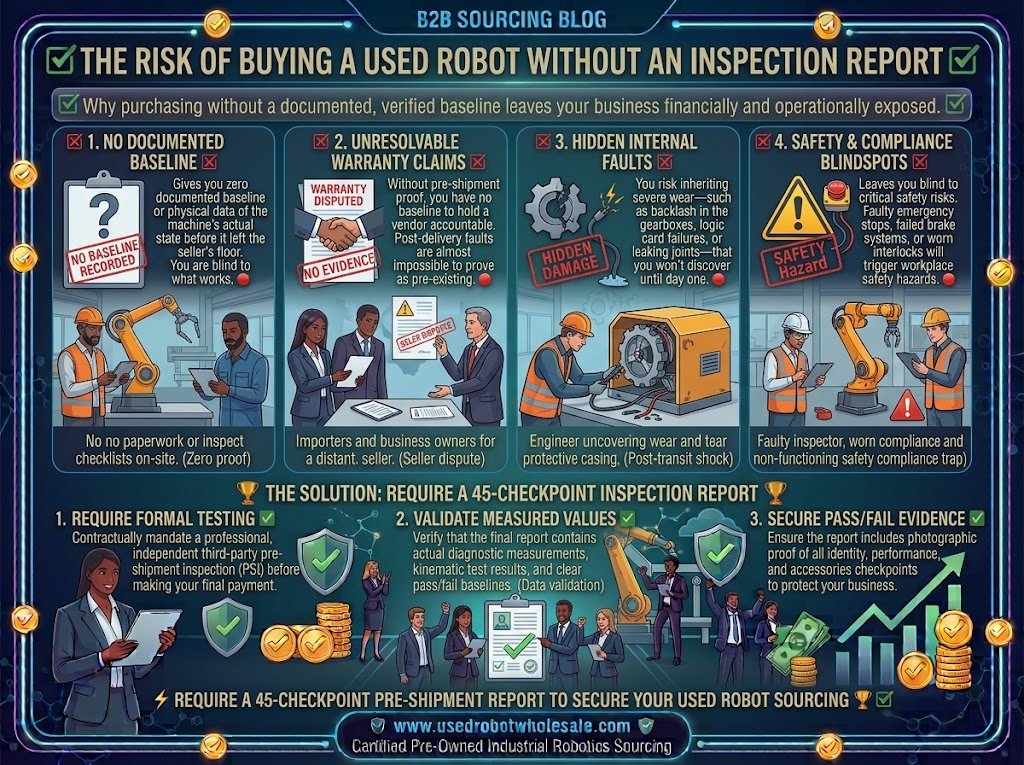 "Why a used robot pre-shipment inspection report protects buyers from risk")
The accountability gap that reports close
Here is the scenario that plays out when no report exists:
- 🔴 Buyer receives a second hand factory automation robot
- 🔴 A fault appears within the first two weeks
- 🔴 Buyer contacts the seller
- 🔴 Seller says the machine was fine when it left
- 🔴 Buyer has no documentation to prove otherwise
A formal inspection report closes that gap. It records what was tested, what was found, and what the machine's actual state was at the moment of inspection. That document becomes the evidence base for any post-shipment claim.
What a middleman without a workshop cannot provide
A real pre-owned robotic arms distributor maintains a physical facility, test equipment, and technical staff. A middleman reselling someone else's machine can't produce a genuine inspection report because they never had the machine in their hands long enough to run the tests.
🚩 Red flag: Any report that marks every single checkbox as "pass" with no actual measurements, no timestamps, and no engineer's name is not an inspection report. It's a template someone filled in to look legitimate.
Why 45 checkpoints specifically
Forty-five is not arbitrary. It reflects the minimum threshold to cover the robot body, control cabinet, and teach pendant, each in enough depth to catch real problems. A 10-item checklist isn't half as thorough as a 45-item one. It skips entire system categories that are among the most common failure points on used machines.
A tested industrial robot barebone unit that actually passes 45 documented tests is a fundamentally different product from one that passed a visual once-over and a 10-minute test run. Our own 45-item outgoing standard at Pengju Robotics was built from 14 years of seeing what fails post-delivery when certain checks were skipped. Every unit in our available stock passes every item before a shipping label goes on.
What Should the Equipment Identity and Appearance Checks Document?
You can't inspect a machine you can't identify. The first section of any real report establishes who the machine is before it covers how it's doing.
The equipment identity and appearance section documents the robot's full identification (brand, model, serial number, manufacture year), usage history (operating hours, repair records), and physical condition (body damage, cable state, flange wear, nameplate integrity). This section catches refurbishment concealment, serial number mismatches, and undisclosed prior damage before any power is applied.
![used robot equipment identity appearance inspection documentation checklist items]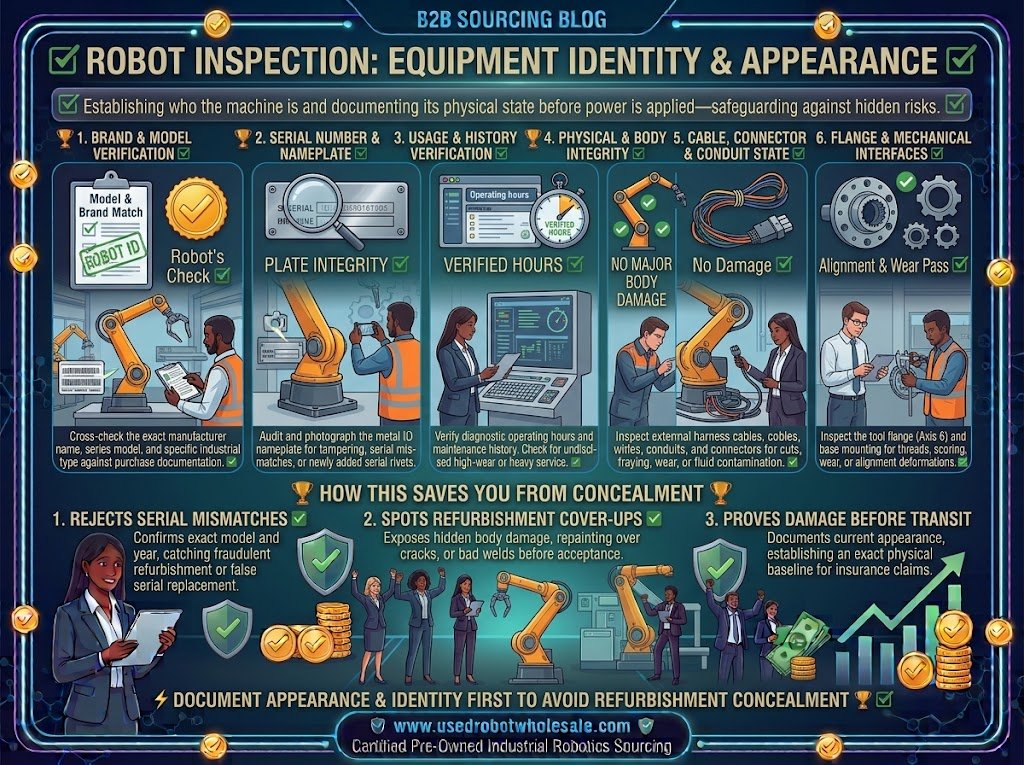 "Used robot equipment identity and appearance inspection documentation checklist")
Section 1 — Equipment identity and history (Items 1–5)
| # | Inspection item | What to verify |
|---|---|---|
| 1 | Report number and inspection date | Dated, numbered, engineer-signed, traceable document |
| 2 | Equipment basic info | Brand, model, SN, manufacture year, origin, manufacturer |
| 3 | Usage history | Backend hour-meter readout, repair records, maintenance logs |
| 4 | Cargo-certificate consistency | Nameplate vs. documentation match, no refurbishment concealment, no parts substitution |
| 5 | Quantity and packaging state | Unit count matches order, industrial robot inventory list against packing documents verified |
Why items 3 and 4 matter most in this section
Item 3 — operating hours — is the machine's odometer. That number can be manipulated. A credible report cross-checks the backend readout against physical wear: grease condition, cable fraying, bearing play, and joint noise. A mismatch between reported hours and physical wear is a direct signal of data manipulation.
Item 4 — cargo-certificate consistency — is where assembled or concealed-refurbishment units get exposed. If the SN on the body nameplate doesn't match the controller's internal system code, or if the body and controller serials belong to different production batches, the unit is very likely an assembly presented as an original complete machine.
Section 2 — Appearance and mechanical state (Items 6–13)
| # | Inspection item | What to document |
|---|---|---|
| 6 | Robot body exterior | Dents, cracks, deformation, rust, oil staining |
| 7 | Joint and module housings | Cracks, wear marks at rotation interfaces |
| 8 | Cables and conduits | Sleeve condition, aging, exposed metal rust |
| 9 | Flange and base | Wear, deformation, fastener torque confirmation |
| 10 | Nameplates and labels | Complete, unaltered, no grinding or overpainting |
| 11 | Interior and cabinet cavity | No debris, waste oil, or undisclosed parts inside |
| 12 | Protective covers and guards | Complete, undamaged, properly fitted |
| 13 | Paint and surface finish | No fresh paint patches concealing impact damage |
📋 Item 13 specifically: Fresh paint in a localized area on an otherwise uniformly aged machine is a classic indicator of concealed impact damage. The inspection should note every paint inconsistency with photographs. A legitimate report documents what it finds, not what a seller wants to hide.
Used FANUC robots in stock at a credible source will show consistent aging across all surfaces. Spot repainting without explanation is always worth a direct question. Browse used FANUC robots, used ABB robots, used KUKA robots, used Yaskawa robots, and other brands with documented condition ratings.
What Should the Electrical and Control System Section Include?
Electrical faults are the most common cause of post-shipment issues with used robots. They're also the hardest to detect without live power-on testing. Visual inspection alone won't catch them.
The electrical and control system section documents the control cabinet's operational state, teach pendant functionality (buttons, screen, emergency stop and enable switch), cable and connector condition, battery charge and discharge performance, power-on voltage tests across all modules, communication interface function, and e-stop and limit switch response. Each item must be tested with the machine powered on, not just visually assessed.
![used robot electrical control system inspection checklist power-on tests control cabinet]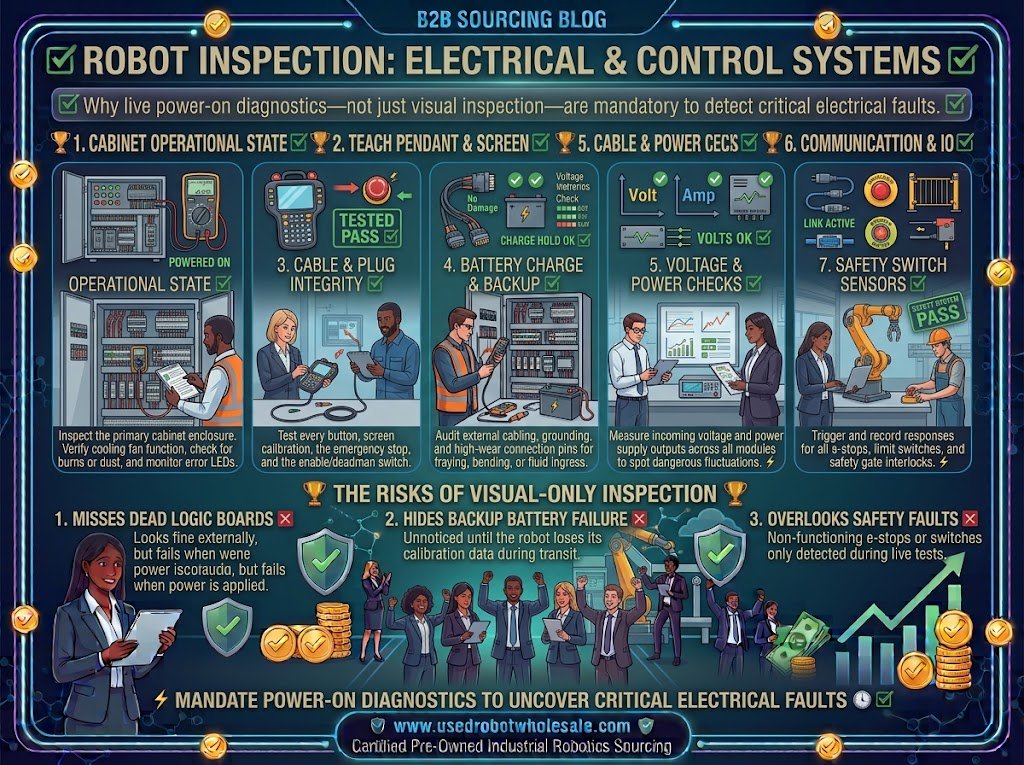 "Used robot electrical and control system inspection checklist with power-on tests")
Section 3 — Electrical and control system (Items 14–21)
| # | Inspection item | Testing method |
|---|---|---|
| 14 | Control cabinet state | Power-on check: alarm log, fan operation, indicator light function, error history review |
| 15 | Teach pendant state | Button actuation test, screen display quality, e-stop and enable switch response |
| 16 | Cable and connector state | Physical inspection and continuity test on critical connection points |
| 17 | Battery state | Voltage measurement, charge/discharge cycle test, data retention after power-off |
| 18 | Electrical safety | Grounding resistance measurement, insulation check, aging assessment on visible cables |
| 19 | Power-on test | Full startup sequence, per-module voltage verification |
| 20 | Communication interface test | All interface types tested for function and signal integrity |
| 21 | E-stop and limit function test | Physical activation, controller response time measurement |
Item 15 — Teach pendant: the most frequently replaced component on used robots
Teach pendants absorb more physical punishment than any other robot component. Buttons wear out, screens degrade, and connectors get damaged from daily handling across thousands of production hours. For a used KUKA KRC4 teach pendant, an ABB FlexPendant, or a FANUC iPendant, the inspection report should specifically confirm button actuation force, screen pixel integrity, and e-stop switch response time — not just note that the pendant "appears functional."
A pendant failure doesn't prevent automatic production, but it stops all manual programming, diagnostic work, and fault recovery. That makes it an operational bottleneck, not just a peripheral.
Item 17 — Battery state: the silent failure point
Robot controllers retain axis calibration data, program memory, and safety configuration on backup batteries. A degraded battery causes the machine to lose its zero-point data after any power interruption. That means a full manual recalibration before production can restart, on your time and at your cost.
⚠️ A battery check that only confirms the battery "looks new" is not a battery check. A new-looking battery can still hold insufficient charge. Only a measured voltage test and a data retention power-cycle confirm actual function.
Obsolete FANUC robot parts and the control section problem
For older FANUC models, obsolete FANUC robot parts in the control section are the hardest to source after a failure. The inspection report should flag any control board, amplifier, or module showing elevated heat signatures, unusual alarm codes, or degraded signal output — because sourcing a replacement after delivery is far more expensive and time-consuming than catching the issue before shipment.
A replacement servo motor for an ABB robot or a drive module for a KUKA controller found faulty during inspection is a pre-shipment repair that protects both buyer and seller. Found post-delivery, the same fault becomes a dispute. Browse our teach pendants, control boards and mainboards, power supply modules, and I/O modules and communication boards to check parts availability before committing to a unit.
What Motion and Precision Tests Must Appear in a Credible Report?
This is the section that separates a real inspection from a paperwork exercise. Motion tests require a powered, running robot and an engineer present to observe and measure. They cannot be faked by reading a spec sheet.
The motion and precision section documents no-load axis operation, loaded performance, repeat positioning accuracy measured against the robot's rated specification, speed and response characteristics, reducer condition including backlash measurement, continuous operation stability, and maximum load capacity verification. This section covers 12 checkpoints and is the most technically demanding part of a complete report.
![used robot motion precision performance inspection tests repeat positioning accuracy reducer]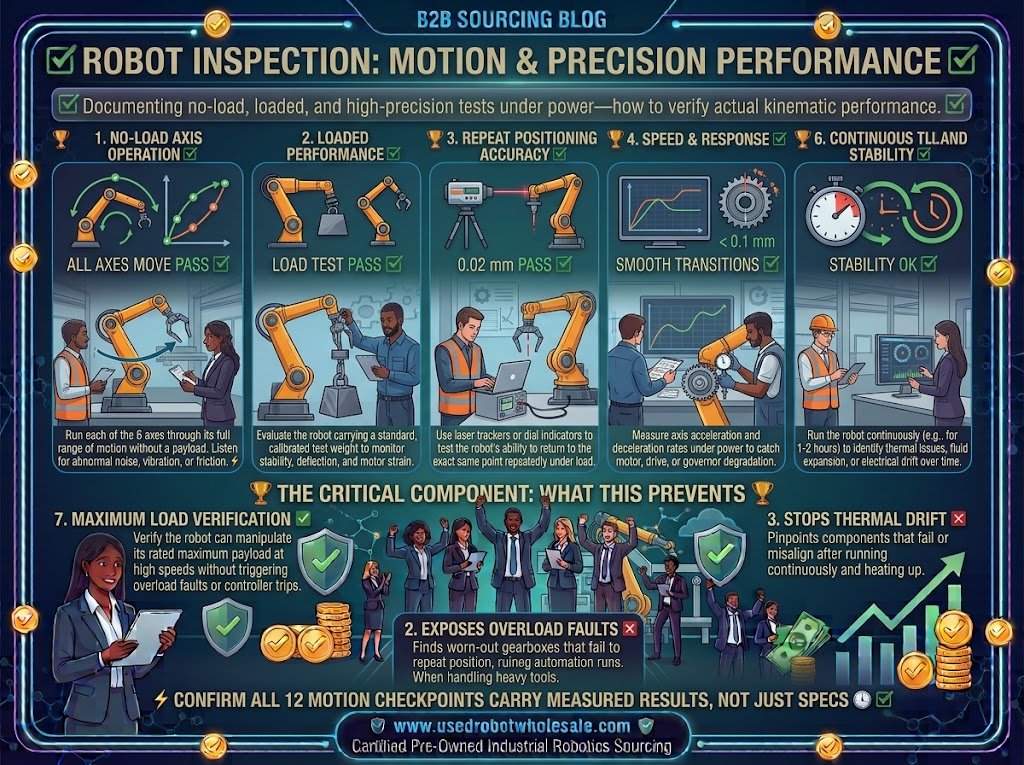 "Used robot motion and precision performance inspection tests 12 checkpoints")
Section 4 — Motion and precision performance (Items 22–33)
| # | Inspection item | Key measurement target |
|---|---|---|
| 22 | No-load operation test | All 6 axes smooth, no noise, no stutter, no vibration at rated speed |
| 23 | Load operation test | Stability and smoothness under rated payload across full working envelope |
| 24 | Repeat positioning accuracy | Measured value vs. rated spec (e.g., ±0.02mm for FANUC M-10iA series) |
| 25 | Absolute positioning accuracy | Deviation between actual and commanded TCP position |
| 26 | Speed and response test | Maximum speed, step response time, acceleration/deceleration curve |
| 27 | Reducer state | Oil seal check, backlash measurement per axis, temperature rise after 30 min |
| 28 | Joint performance test | Torque output, rotational speed, and temperature rise per individual axis |
| 29 | Vibration and noise test | Vibration amplitude (mm/s), noise level (dB) at rated operating speed |
| 30 | Continuous operation test | Minimum 4-hour run at rated duty cycle, fault log cleared, stability confirmed |
| 31 | Trajectory accuracy test | Complex path execution, TCP path deviation measurement |
| 32 | Joint synchronization test | Multi-axis coordinated movement timing and positional consistency |
| 33 | Load capacity test | Rated payload at maximum reach verified under controlled conditions |
Item 24 — Repeat positioning accuracy: the metric buyers most need
For a used robot arm for welding cell work, an assembly application, or a machine tending setup, repeat positioning accuracy directly determines whether finished products meet dimensional specification. The report must state the actual measured result from a calibration run, not just confirm "meets specification" without a number.
A unit rated at ±0.05mm delivering actual performance of ±0.18mm will produce visible weld bead inconsistencies, misaligned part placements, and missed tool points in a real production cycle. Only a measurement protects you.
Item 27 — Reducer condition: the most expensive repair on any used robot
A reducer replacement on a main axis typically costs 15,000–50,000 yuan depending on the axis, brand, and model. A credible inspection includes all of these:
- Backlash test at each axis with the motor holding a commanded position
- Listening check for grinding, irregular clicking, or periodic noise at low speed
- Oil seal inspection at every output housing for seepage or staining
- Temperature rise measurement after 30 minutes of continuous operation
Item 30 — What a 4-hour continuous run actually reveals
Short test runs hide intermittent faults. A 4-hour continuous operation test at normal production duty cycles surfaces:
- 🌡️ Thermal management failures — components running fine for 10 minutes, then overheating
- 🔊 Intermittent joint sticking that worsens as lubricant heats up and thins
- 📶 Communication bus faults that appear only under sustained controller load
This is the test that exposes hidden problems a dishonest seller most wants to avoid. A complete used welding robot going into a production weld cell needs proven continuous trajectory accuracy. A used palletizing robot system running 18-hour shifts needs to demonstrate duty cycle stability. No five-minute test run replaces that data. See our welding robots, palletizing robots, handling robots, and machine tending pages for application-specific context.
What Do Safety, Compliance, and Documentation Checks Prove?
The first four sections test whether the robot works. This last section tests whether the purchase is complete — legally, technically, and commercially.
The safety and documentation section covers 12 checkpoints including mechanical safety device function, electrical safety compliance, EMC performance, and the full documentation package: technical manuals, historical inspection records, accessories list, packaging documentation, and the seller's written after-sales service commitment. This section transforms a machine sale into a verifiable, supported transaction.
![used robot safety compliance documentation checklist accessories after-sales commitment]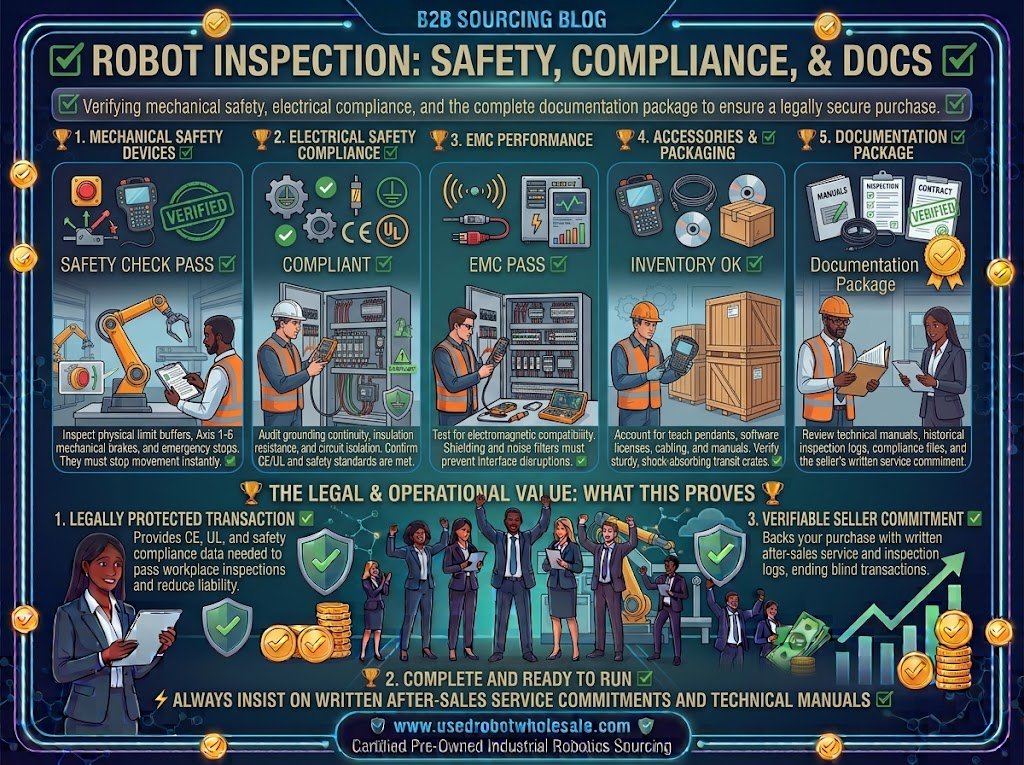 "Used robot safety compliance and documentation inspection checklist accessories")
Section 5 — Safety and compliance (Items 34–40)
| # | Inspection item | What to verify |
|---|---|---|
| 34 | Mechanical safety protection | E-stop response time, limit interlock function, guard physical integrity |
| 35 | Electrical safety compliance | Grounding resistance measurement, insulation resistance, leakage current |
| 36 | EMC test | Radiated emission check, susceptibility under industrial-level interference |
| 37 | Environmental adaptability | Performance stability confirmed across operating temperature range |
| 38 | Energy efficiency compliance | Power consumption within rated specification under load |
| 39 | Special equipment compliance | Manufacturing records, type test certification where applicable by jurisdiction |
| 40 | Safety labels and warnings | All safety markings present, legible, correctly positioned |
Item 34 — E-stop function: never optional
Every robot in a shared workspace must have a verified, measured e-stop. The report must record the response time from button activation to full motor stop, and confirm the limit interlock prevents movement outside the defined work envelope. This isn't a best practice recommendation. In most industrial jurisdictions, it's a legal requirement for installation.
Section 6 — Accessories and documentation (Items 41–45)
| # | Inspection item | What a complete package includes |
|---|---|---|
| 41 | Technical documentation | User manual, maintenance manual, circuit diagrams — confirmed in buyer's language |
| 42 | Historical inspection records | Prior service records, third-party test reports where available |
| 43 | Accessories and tools list | Calibration tools, spare connectors, original grease kit — itemized and present |
| 44 | Packaging and shipping documentation | Confirmed packing list, transport labels, appropriate anti-shock packaging |
| 45 | After-sales service commitment | Written warranty period, repair policy, tested used robot spare parts availability, technical support contact |
Item 41 — Documentation actually in a language your team can read
A maintenance manual in a language your engineering team can't read is a documentation gap, not a documentation success. Any export-oriented used robot supplier China buyers work with should supply bilingual or translated documentation for critical service information. This is especially important for models with limited online support resources in the destination country.
Item 45 — The written after-sales commitment is the final proof
This item is where the seller's accountability is tested beyond the sale. A legitimate report includes:
- Warranty period: Minimum 3 months, ideally 6–12 months for a fully inspected unit
- Repair policy: Who handles in-warranty faults, at whose cost, within what response timeframe
- Parts availability: Written confirmation that spare parts for this model are currently in stock
- Technical support: A named contact with response time commitment for commissioning questions
💬 My honest view on this: If a seller can't produce a written version of item 45, treat that as seriously as a failed mechanical test. A verbal warranty expires the moment the transaction closes. A written one doesn't.
Browse our full robot spare parts and all robot parts catalog to verify parts availability for your specific model before you commit. Our new arrivals page shows recently tested incoming units with current inspection status.
Conclusion
A 45-point report covers the machine, the controller, the teach pendant, the safety systems, and the full paper trail. Anything shorter leaves real gaps. Gaps become production problems.
Every unit at Pengju Robotics ships with a signed 45-point inspection report. Browse our all used robots catalog or read more buyer guides on our blog.
About Pengju Robotics

Pengju Robotics Co., Ltd. has operated in the used industrial robot market since 2012. We handle robot trading, automation integration, equipment leasing, robot and spare parts sales, repair, maintenance, and technical training. Our service centers operate in Shenzhen, Chongqing, Xiong'an, and our headquarters in Changsha.
Our physical inventory stays above 1,000 units. Every outgoing unit passes our own 45-item inspection standard, covering the complete machine, robot body, control cabinet, and teach pendant, assessed by our in-house engineering team. Our 58-person staff divides across simulation engineers, field commissioning engineers, and after-sales support staff.
Our standard since day one: strictly abide by every standard, responsible for perfect delivery.
🏢 Company: Pengju Robotics Co., Ltd.
📍 Address: No. 3, Maqiaohe Road, Wangcheng District, Changsha City, Hunan Province, China
📧 Email: sales@pengjurobotics.com (primary) · purchase@pengjurobotics.com · info@pengjurobotics.com
📱 WhatsApp / WeChat (Tony): +86 18123897892
Reach us through our contact page or learn more about us.