Most resellers eyeball their margin. That works fine until a repair bill arrives and the deal that looked profitable suddenly isn't. The used industrial robots wholesale market has no published price list.
No Blue Book, no official rate card, no standard markup. Every margin is calculated individually, and the resellers who do it well are the ones who treat it like a formula.
A used robot reseller's margin equals resale price minus total cost. Total cost has four parts: purchase price, refurbishment and repair spending, capital holding cost during the selling period, and operating costs including logistics, storage, and channel fees. The resale price is set using either market comparison data or a cost-plus markup. Using both methods together gives you the most defensible price.
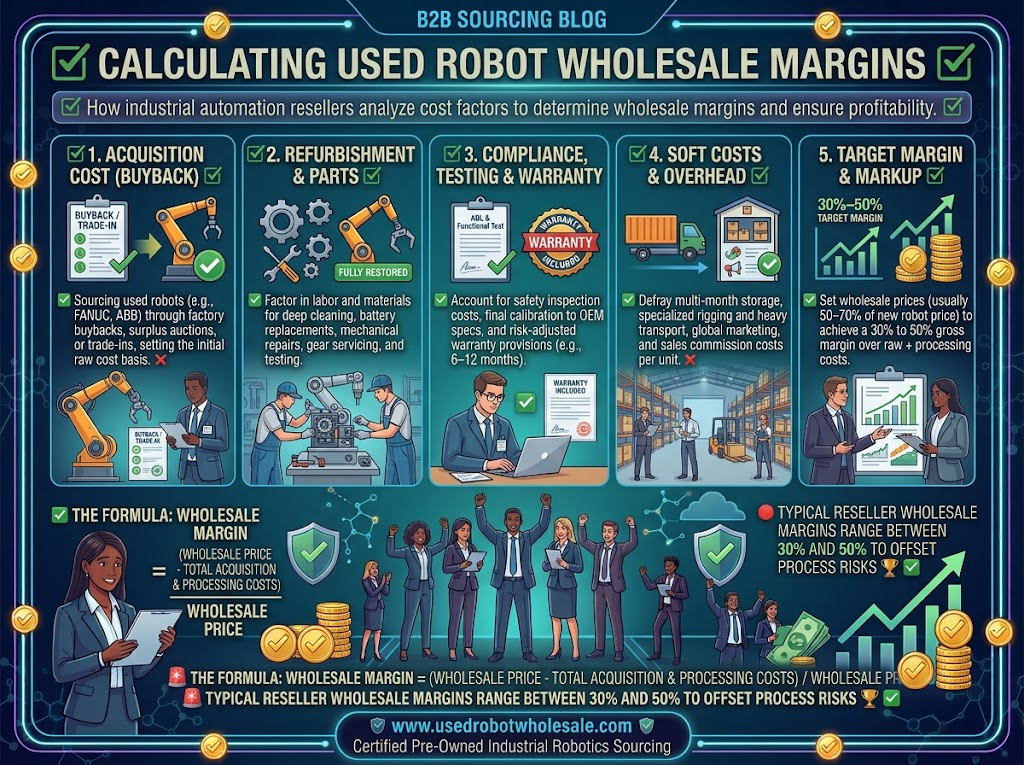
Here's what makes this market genuinely interesting. The supply side draws heavily from surplus industrial automation equipment released by factories upgrading their lines or exiting production. That constant influx creates price volatility that makes margin calculation both challenging and profitable for resellers who understand the mechanics. Whether you're a pre-owned robotic arms distributor building a pricing model from scratch, or a factory buyer trying to understand whether a quote is fair, the same formula applies. Let me walk through every layer of it.
What Is the Core Formula Every Used Robot Reseller Should Know?
Without a formula, margin is just a feeling. And a feeling doesn't survive the moment a repair bill shows up and a customer asks for a discount in the same week.
Resale margin equals resale price minus total cost. Total cost is the sum of four components: purchase price, refurbishment and repair cost, capital holding cost, and operating and channel cost. Missing even one of these four in your calculation means your actual margin is lower than your estimate, sometimes significantly.
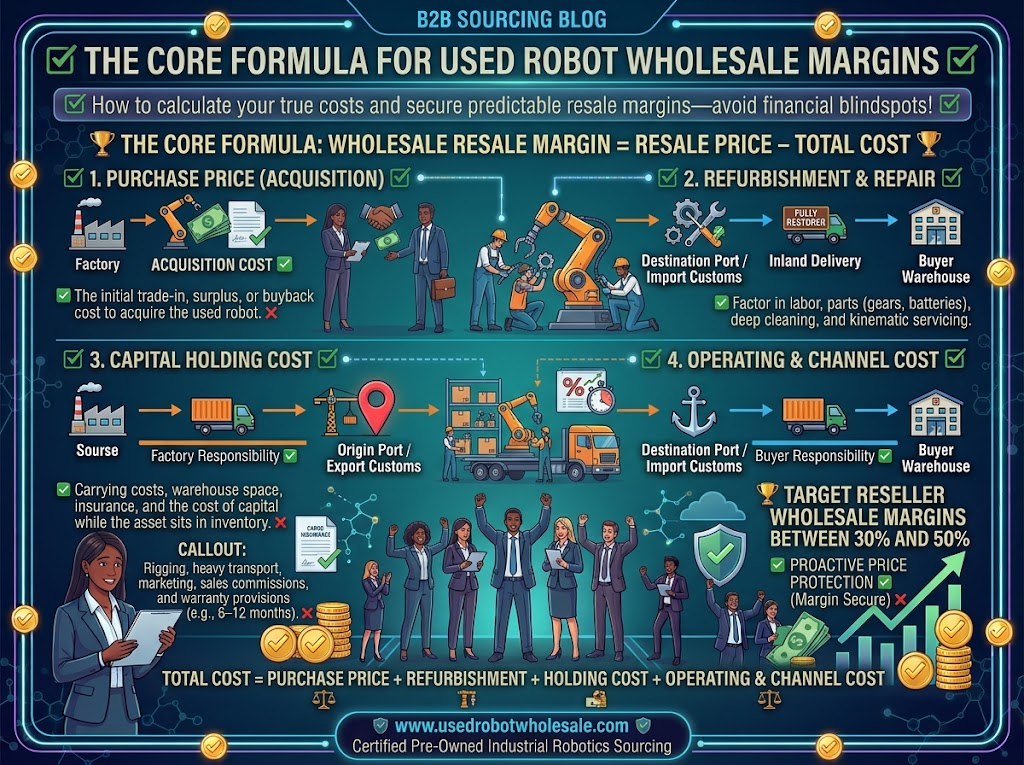
The four-layer cost structure
Think of your total cost as a stack. Every layer reduces the gap between what you paid and what you can charge.
| Cost component | What it includes |
|---|---|
| 📦 Purchase cost | Price paid to the original seller, scrapper, or factory |
| 🔧 Refurbishment & repair cost | Inspection fees, parts, testing, cleaning, re-greasing |
| 💰 Capital holding cost | Interest on financed capital, or opportunity cost on owned capital |
| 🚚 Operating & channel cost | Freight, storage, marketing, platform fees, sales commissions |
Why capital holding cost gets ignored most often
Used industrial robots are heavy assets. A machine sitting in your warehouse for three months generates zero revenue but still generates cost. If you financed the purchase, that interest accrues daily. If you used your own cash, the opportunity cost of that money is real even when it doesn't appear on an invoice.
💡 Working benchmark: Experienced resellers in the second hand factory automation robots market often factor in capital holding cost at roughly 1–2% of purchase price per month. A robot bought for 50,000 yuan and held four months before sale carries 2,000–4,000 yuan in pure holding cost before a single repair is counted.
A worked example with real numbers
A used robot reseller buys a six-axis FANUC arc welding robot:
- Purchase cost: 50,000 yuan
- Refurbishment cost (inspection, encoder swap, grease, cleaning): 6,000 yuan
- Capital holding — 3 months at 1.5%/month: 2,250 yuan
- Operating costs (shipping, storage, platform listing): 3,500 yuan
- Total cost: 61,750 yuan
At a resale price of 78,000 yuan, gross margin is 16,250 yuan — roughly 20.9% of the resale price.
The formula works the same way across every model and application. A used palletizing robot system or a complete used welding robot cell follows identical logic. The numbers change. The structure stays the same.
How Do You Calculate the Resale Price of a Used Industrial Robot?
Price too high and your machine sits in storage accumulating holding costs. Price too low and you leave margin on the table. The right number sits in a specific, definable window — and there are two reliable ways to find it.
The resale price of a used industrial robot is set using either the market comparison method (benchmarked against recent transactions for the same brand, model, age, and condition) or the cost-plus method (total cost plus a target markup, most useful for refurbished or high-value units). Most experienced resellers use both methods and price within the range where they overlap.
![how to calculate resale price used industrial robot market comparison cost plus methods]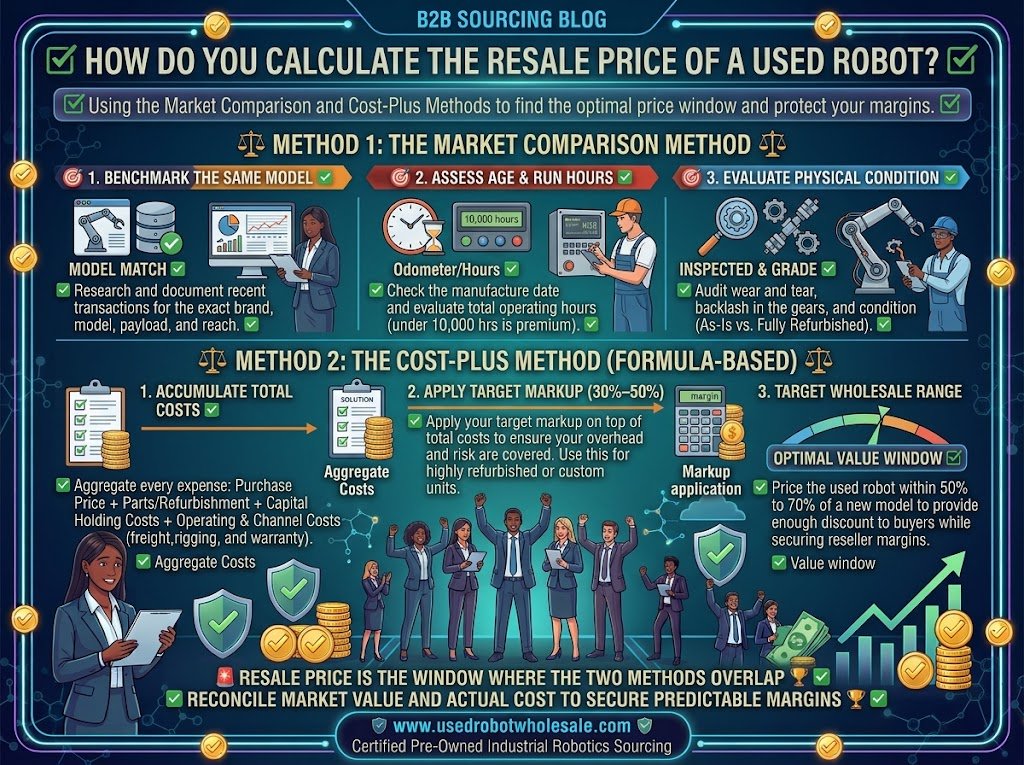 "How to calculate used industrial robot resale price market comparison cost plus")
Method 1 — Market comparison (the most common approach)
Step 1: Build a comparable transaction dataset
Search for sales of the same brand, model, production year, and working condition from the past six months. A six-month window is important. Robot market prices shift with industry cycles, exchange rates, and new-model releases that push down older generation values.
Step 2: Adjust for your unit's real condition
| Condition factor | Price adjustment guide |
|---|---|
| Clean history, under 8,000 hours | +10% to +15% above comparable average |
| Normal wear, 8,000–15,000 hours | At market average |
| Heavy wear or documented fault history | -10% to -20% below average |
| Discontinued model, scarce parts | -15% to -25%, or hold for the right specialist buyer |
Step 3: Factor in market demand
Popular configurations of used FANUC robots in stock, particularly common welding and handling setups, hold their value well. Uncommon configurations, very old models, or machines with brands that have lost regional service support move slower and need a competitive price to clear.
We track our own industrial robot inventory list with condition ratings and market position across all brands. Browse all used robots and our available stock page to see how current listings are positioned for used FANUC robots, used ABB robots, used KUKA robots, used Yaskawa robots, and other brands.
Method 2 — Cost-plus pricing (for refurbished or warranted units)
For a refurbished industrial robotic arm that's been fully inspected, repaired, tested, and issued with a written warranty, market comparison pricing often undervalues the unit. Buyers pay a premium for certainty, and certainty costs real money to produce.
A standard cost-plus markup for fully restored units with documentation runs 30–50% over total cost. A tested industrial robot barebone unit with complete inspection records sits in a different pricing tier than an uninspected unit of the same model, even if the base part numbers match.
What Costs Actually Eat Into a Reseller's Margin?
Most resellers track the gap between buy price and sell price. The four costs sitting in between that gap are where the real margin management happens — and where undisciplined resellers lose money quietly over time.
The four costs that reduce gross margin are purchase price, refurbishment spending, capital holding, and operating costs. Each one is partially controllable. Ignoring any of them creates a false margin figure that only becomes visible at month-end or when a deal goes wrong.
![used robot reseller cost breakdown refurbishment capital holding operating costs per unit]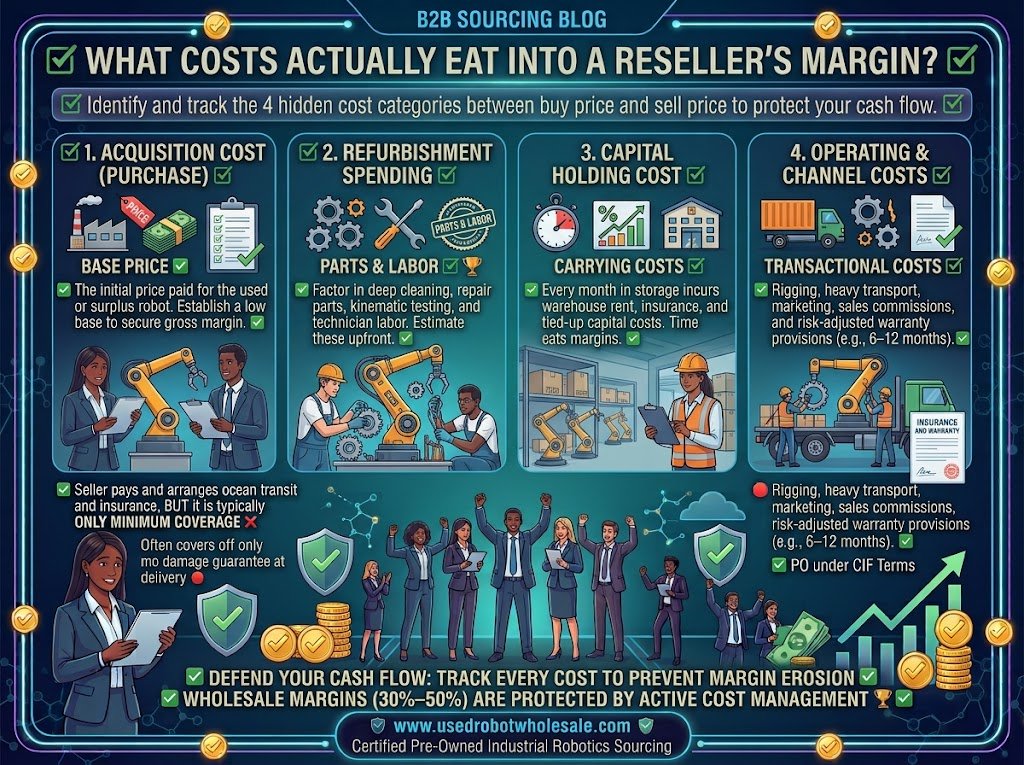 "Used robot reseller cost breakdown refurbishment capital operating costs")
The refurbishment cost trap
Refurbishment costs are the hardest to estimate before you open a machine. An inspection might reveal nothing. It might reveal a failed servo drive, a cracked harness, or a teach pendant that needs full replacement.
Common refurbishment line items:
- Inspection and diagnostics: Axis calibration, aging run test (typically 8–24 hours), fault log review
- Parts replacement: Tested used robot spare parts including servo motors, encoder units, boards, and teach pendants
- Consumable servicing: Full grease replacement on all axis joints, backup battery replacement for controller data retention
- Cosmetic refurbishment: Deep cleaning, surface touch-up, label replacement for professional presentation
⚠️ A refurbishment budget built on optimism is not a budget. Always reserve a contingency of 15–20% above your refurbishment estimate for unexpected finds inside the enclosure. The surprises are almost never positive.
Parts costs by brand: what to expect
| Brand | Common repair line items to budget |
|---|---|
| FANUC | Obsolete FANUC robot parts (pulse coder, servo amplifier), teach pendant, grease kit |
| ABB | Replacement servo motor for ABB robot, I/O board, power supply module, SMB battery card |
| KUKA | Used KUKA KRC4 teach pendant, KRC4 main board, safety control board |
| Yaskawa | Servo pack, NX100 control board, battery replacement kit |
Browse our parts catalog by category before committing to a machine to pre-build your refurbishment cost estimate: teach pendants, servo motors, servo drives and amplifiers, control boards and mainboards, power supply modules, and encoders and resolvers.
Operating costs: the numbers that accumulate quietly
These cost items look small individually. Across ten units in inventory over a month, they become meaningful:
- Domestic freight for a 300kg robot body: 1,500–3,500 yuan by distance
- Monthly storage cost per unit: 500–1,500 yuan depending on facility type
- Platform listing and transaction fees: 2–5% of sale price on major B2B channels
- Sales team commission: 2–5% of transaction value, depending on deal structure
An accurate running inventory list with condition ratings, acquisition dates, and projected holding durations is the starting tool for calculating your real carrying cost per unit. Without it, capital holding and storage costs stay invisible until they've already eaten your margin.
When Should You Use Market Pricing vs. Cost-Plus Pricing?
Using the wrong method for a given unit either prices you out of the deal or leaves margin behind. The right method depends on what the unit is, what you've invested in it, and how the buyer is making their decision.
Use market comparison pricing for standard used units in typical condition, where buyers compare multiple listings and have price reference points. Use cost-plus pricing for fully tested, warranted, or refurbished units where the added certainty justifies a premium, and where the buyer is making a value decision rather than a price comparison.
![when to use market pricing vs cost plus pricing used industrial robots resellers guide]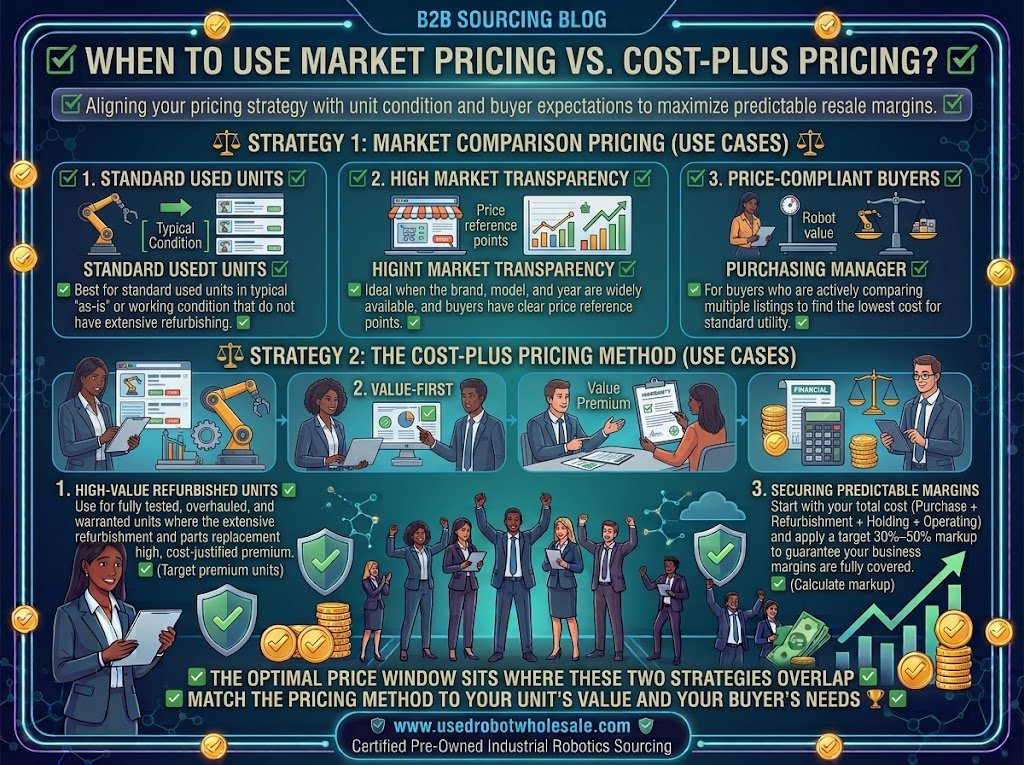 "When to use market vs cost-plus pricing for used industrial robot resellers")
Matching the method to the situation
Market comparison is the right method when:
- The buyer is an experienced dealer who already knows market prices
- The unit is in standard, unrefurbished condition with no unusual investment
- You're competing directly against other listings of the same model on a platform
- The deal is moving fast and both parties want a quick price reference
Cost-plus is the right method when:
- You've invested heavily in refurbishment and need margin recovery
- The unit carries a written warranty that buyers are paying for
- The buyer is a factory or production manager making an ROI decision
- Comparable market data is thin because the model is scarce or highly specialized
The value-based extension: pricing against ROI
The most powerful pricing lever for high-quality units goes beyond either method. It's value-based: the price is set against what the robot saves the buyer, not just what comparable units sell for.
A cost-effective industrial robot replacing one manual production shift typically saves a factory 80,000–120,000 yuan per year in combined labor, insurance, and overtime costs. When a buyer can see that arithmetic clearly, a price 15–20% above the market average starts to look like a bargain rather than a premium.
Walk the buyer through their numbers. Help them calculate their ROI. That calculation directly supports a higher price point. Browse our by-application catalog organized by task: welding robots, palletizing robots, handling robots, machine tending, and assembly robots for cost-effective options by application type.
How Do End Buyers Think About ROI, and Why Does It Affect Your Price?
Every reseller eventually hits the buyer who hesitates and asks: "What if I just buy a new machine?" Understanding how to answer that question changes what price your used robot can command.
Over three years, a used arc-welding robot typically runs 10–15% less than a new equivalent in net cost after factoring in one mid-life repair and residual value difference. But the year-one cash flow advantage is dramatically larger, often 30–40% less upfront cost. That first-year cash flow gap determines whether a small factory commits to automation at all, and it's the core argument that supports a premium price on quality used units.
![used robot vs new robot ROI comparison three year cost analysis buyer perspective]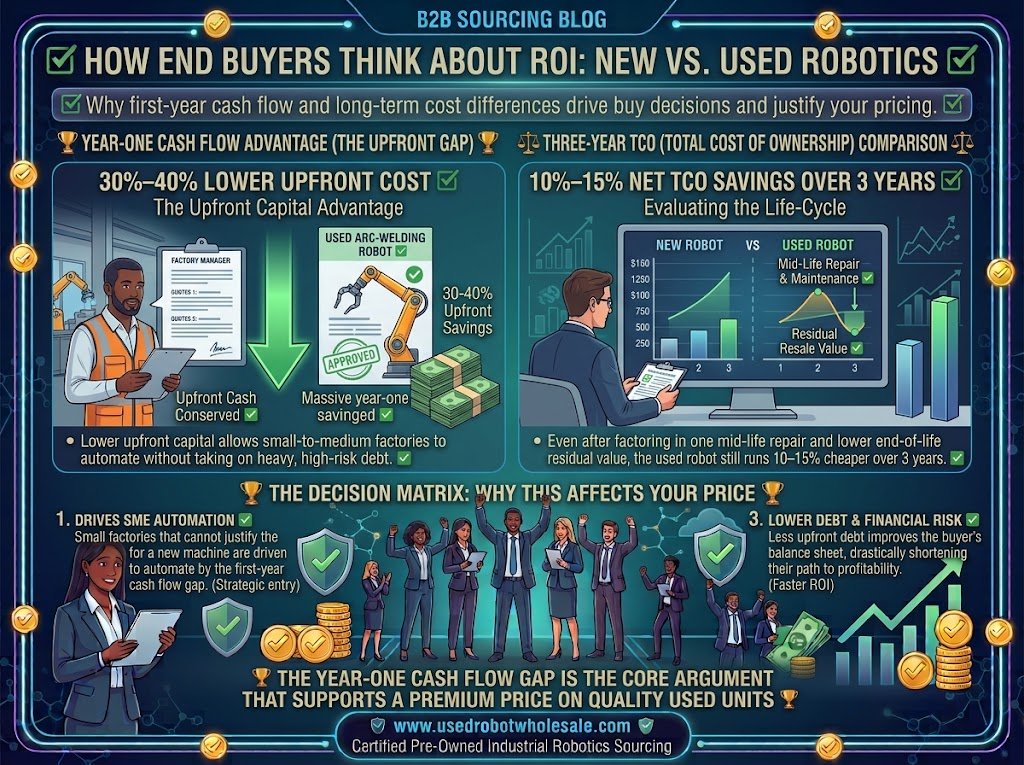 "Used vs new robot ROI comparison three year cost analysis for buyers")
A real three-year cost comparison
We run this comparison with clients regularly. The numbers below are based on actual transactions for an imported-brand arc welding robot (6-axis, 6kg payload):
| Cost item | New robot | Used robot |
|---|---|---|
| Purchase price | ~150,000 yuan | ~60,000 yuan |
| Installation & commissioning | ~30,000 yuan | ~20,000 yuan |
| Maintenance (3 years, incl. 1 mid-term repair for used) | ~45,000 yuan | ~33,000 yuan |
| 3-year total investment | ~225,000 yuan | ~113,000 yuan |
| Residual value after 3 years | ~100,000 yuan | ~25,000 yuan |
| 3-year net cost | ~125,000 yuan | ~88,000 yuan |
Year-one cash flow difference: approximately 97,000 yuan in favor of the used unit.
That first-year gap is the number that matters most to a small or mid-sized manufacturer. Most production businesses run tight on working capital. Freeing up 97,000 yuan in year one lets them fund materials, run a second product line, or test automation on one cell before scaling to the next.
The payback period argument in action
A client we worked with bought a used FANUC robot for a welding cell with a total investment under 120,000 yuan. By adding one new welding shift worth of capacity, they recovered the full cost in under six months. The next two and a half years were pure operating profit from that investment.
💬 The framing that works with hesitant buyers: "A new robot costs more capital today and takes longer to recover. A used robot arm for welding cell work gets you into automation faster, with lower risk. If the production line performs, you can upgrade later. If it doesn't, your exposure is lower."
That argument supports a higher price for your used unit — because you're not just selling a machine. You're selling a lower-risk entry point into automation with a faster payback. Check our new arrivals for recently tested stock, and browse our full used robots catalog to match units to your buyer's production application.
Conclusion
Margin lives in the formula, not in the gut feeling. Track all four costs, pick your pricing method by buyer type, and support your price with the ROI argument when it matters.
Ready to source from a used robot supplier China resellers depend on? Browse our robots and robot spare parts catalog at Pengju Robotics, or find more reseller guides on our blog.
About Pengju Robotics

Pengju Robotics Co., Ltd. has operated in the used industrial robot market since 2012. We handle imported robot trading, automation integration projects, equipment leasing, and robot and spare parts sales, repair, and maintenance. We serve resellers, wholesale dealers, and end-user factories across global markets from service centers in Shenzhen, Chongqing, Xiong'an, and our headquarters in Changsha.
Our physical inventory stays above 1,000 units. Every outgoing unit passes a 45-item inspection covering the robot body, control cabinet, and teach pendant. Our team covers simulation engineering, on-site commissioning, and full after-sales support.
Our standard since day one: strictly abide by every standard, responsible for perfect delivery.
🏢 Company: Pengju Robotics Co., Ltd.
📍 Address: No. 3, Maqiaohe Road, Wangcheng District, Changsha City, Hunan Province, China
📧 Email: sales@pengjurobotics.com (primary) · purchase@pengjurobotics.com · info@pengjurobotics.com
📱 WhatsApp / WeChat (Tony): +86 18123897892
Reach us through our contact page or learn more about us.